****Spoilers for Bridgerton season 4****
Keeping Up with the Regency Era Kardashians just wrapped its fourth and most interesting season to date. Queen Charlotte, of course, remains my most favorite of the Bridgerton universe because there’s at least an attempt to reckon seriously with what it means to be Black in these spaces. But Bridgerton season four is finally about class in a way that all the other seasons have only addressed in the margins. Yes, the Bridgerton family is extremely wealthy compared to other families, but their competitors in the Ton at least could stand in the same rooms, bow before the queen with them and attend their parties. Like the Featheringtons, Bridgerton competitors could also marry into the Bridgerton family, thus increasing their own status and diluting the need to compete.
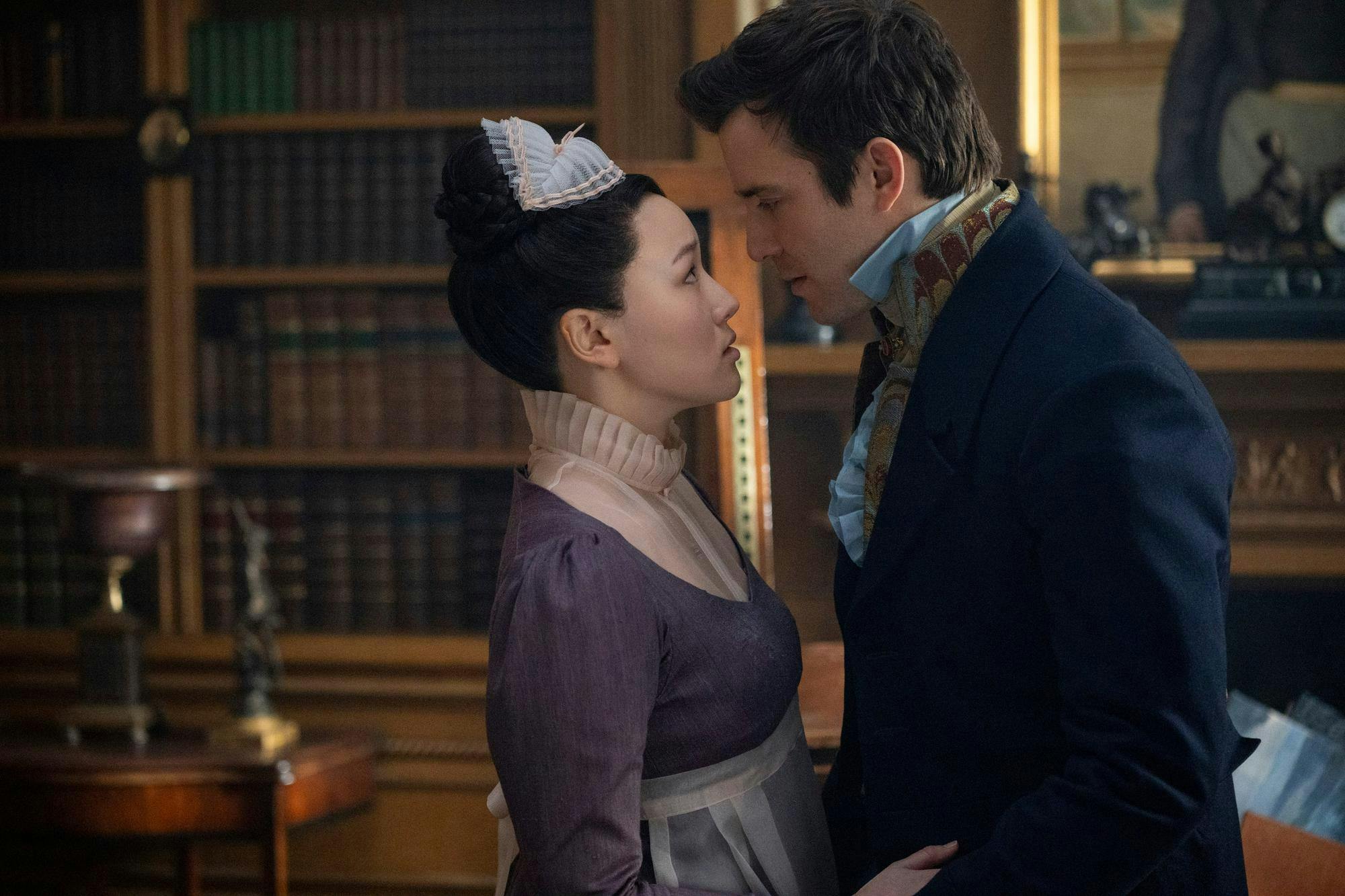
Then the second son, Benedict, fell in love with a maid.
This proves to be an inconvenient scenario not just for Benedict (Luke Thompson) and his maid(en) Sophie (Yerin Ha), who cannot marry without being ostracized from high society in scandal, but also for the audience. It’s capaganda (capitalist propaganda, if you will), this fantasy that Bridgerton offers its significantly poorer audience. It’s an escape into a bygone world of gentlemen, ladies, mansions and balls, and, above all, romance. The Queen (Golda Rosheuvel) is Black! So, never mind that the luxury and leisure of the English court are made possible by its booming Trans-Atlantic Slave Trade. The Featheringtons’ maid, Mrs. Varley, is like a co-conspiring bestie to Mrs. Featherington! So, never mind that the maintenance of the luxury and leisure of the Ton falls on a servant class who work their entire lives for the lords and ladies and will never manage to escape their servitude. That’s too deep for polite conversation.
But with Sophie as the romantic lead of the season, Bridgerton breaks with form and shows us the brutal, disgusting process of how the sausage is made—and then expects us to want more sausage. In a pair of striking scenes, we first see Benedict and his brothers playing a joyous game of Pin the Shaving Cream on the Brother. Immediately afterwards, we see a maid on her hands and knees cleaning up the mess the brothers made and simply left behind.
Later in the season, as Mrs. Featherington snaps at her new maid for not being as good as Mrs. Varley, who quit over the Featheringtons’ disrespectful wages, fan-favorite Penelope Bridgerton (Nicola Coughlan) is seen scolding her mother for being rude to the help. They’re meant to be kind to the help, like the benevolent Bridgerton matriarch Violet. Throughout the season, Sophie checks Benedict on his immeasurable privilege and ignorance over how much strife he puts his servants through on a daily basis. And all I can think about is, are we supposed to like these insufferable people now that we’ve gotten to know the human beings who wait on them, hand and foot?
You have people whose entire lives are about serving you, raising your children, dressing and undressing you, chauffeuring you wherever you want to go, when you want to go there. You have people whose lives consist of cooking your food, serving it you, and cleaning up after you when you’re done. They throw out your chamber pot piss in the morning and draw your curtains when you wake up. And we’re supposed to go back to relating and rooting for the rich people after what we’ve seen?
But this is the appeal of the show. It’s bigger than “steamy love scenes”— we’re supposed to long just as much for the day when we can live as comfortably as the Bridgertons, at someone else’s expense. This is what makes Sophie’s story a fairytale, in the first place.
Through Benedict’s insistence on being with Sophie despite the ruin he could bring to his family, or to himself by being cut off from the family, season four offers both an escape from class strife and a prison. Love, the ultimate liberator, has come to set Sophie free. But of course, only Sophie. As much as the white Bridgertons love to collect marginalized spouses, they do so only as much as their wealth, power and status in the Ton are secured — much like their IRL Kardashian counterparts.
The Sophie-Benedict Cinderella story had the potential to shake up the Ton and to buck the social order, as Benedict declared that he wished he could do. Violet Bridgerton had hatched a plan with Lady Danbury and the Queen’s newest lady in waiting, Alice Mondrich, to make the Queen bless a marriage between the classes, thus upending the social order. But that’s not quite what happens, because that’s not quite what Bridgerton is about.

Look no further than the Mondriches. The aforementioned lady-in-waiting, Alice, and her husband Will had much humbler beginnings. Will is introduced in season one as the Black friend and counterpoint to the Black duke, Simon. Where Simon was born into title and wealth, Will was born into slavery but escaped to Britain, became a boxer and befriended local rake Simon. When Will wanted to build a gentleman’s club, Simon invested and his Bridgerton brother buddies patronized him, making Will everyone’s new Black friend of a different class. While Simon has never been seen again after season one (thanks, at least in part, I’m sure, to the racist fans of the show and book series), Will and Alice, have persisted.
And without a regular Black male constant on the show who is on equal footing with the Bridgertons (thanks to the absence of Simon, Lady Danbury’s fine little brother Marcus, and now with the death of Francesca’s husband, John Stirling) Will and his wife have been promoted to the job. The biracial Alice has a white aunt of status with no surviving heirs, so her estate and family titles go to Alice and Will’s son, elevating Alice and Will to members of the Ton. Will’s storyline in season 3 consists of him wrestling with giving up the club he worked so hard for in order to be a member of society. Gentlemen do not work! They enrich themselves off of the labor of others! That is the trade and the formerly enslaved Will reluctantly but ultimately makes it. As a result, this high society loophole allows Alice to be promoted to lady-in-waiting for the Queen in season 4. Find the cracks and crevices and sneak the colored folk in, if you must! But that status quo will be maintained.
We saw as much in season two, when Eloise Bridgerton, in her search to uncover the person behind town gossip rag Lady Whistledown, fell into a bit of flirtation with a bookshop worker named Theo. He gave her his favorite books to read and introduced her to the political activism brewing underneath the Ton’s polished veneer. Lady Whistledown wrote about Eloise and Theo’s friendship and nearly ruined Eloise and the entire Bridgerton clan’s standing in society. The stakes in this and every season have been about this potential loss of power and status, and how hard the gatekeepers of the family—Violet and Anthony in particular—are willing to work to make sure that never happens.
So, instead of Benedict marrying a maid, Violet blackmails Sophie’s enslaver into pretending that Sophie is a legitimate daughter of Lord Penwood’s house. Though the Queen knows this is a lie, she’s deeply amused by her favorite Kardashian soap stars’ shenanigans, and lets it all slide with uproariously laughter. Benedict and Sophie marry and the status quo remains in place.
Capaganda requires the audience to turn off our brains in order to root for and aspire to be like our oppressors. Our heroes, the Bridgertons, are landlords, for crissake! Bridgerton took a serious risk in upending that social contract by making us remember that the servants are people with lives who are deeply impacted, mostly negatively, by their spoiled, pampered, thoughtless enslavers—whether that’s the Queen, the Bridgertons, the Featheringtons, the Penwoods or any of them— and that there’s no such thing as “the good kind” of enslaver. Benedict wields his power over Sophie in the same uncomfortable ways that Mrs. Featherington wielded hers over Mrs. Varley, and the Queen wielded her power over Lady Danbury—at the end of the day, there can’t be equality, true friendship or love when one holds the other’s livelihood and future in their hands.
Penelope is the only one who recognizes as much this season when she finally lets go of the Lady Whistledown mantle that made her famous and important. She’s a Bridgerton now, and the mother of the new Lord Featherington. The powerlessness from which she created Lady Whistledown no longer exists. In the vacuum Penelope leaves behind in order to pursue other forms of writing, a new Lady Whistledown emerges. People have speculated that it’s Mrs. Varley, someone invisible enough as a maid to get the tea and spill it. Let me dispel that notion right now: the maids have jobs! 24-7! They are too busy to produce a weekly gossip magazine! Lady Whistledown is a bored woman’s job. It’s likely Alice Mondrich who, as a lady-in-waiting, has nothing to do all day but hold dogs, wear wigs, and find gossip for the Queen.

In its focus on class and power this season, the disability representation was incredible, featuring a lord in a wheelchair on the marriage mart; a maid with a limb difference (Gracie McGonigal who plays Hazel) and Francesca and John’s autism-coded characters. All of these disabled characters (and some disable actors) just existed without their disabilities being the center of their storylines. Each were allowed to experience or search for love, unencumbered—if a bit in the background in the case of Hazel the maid and the young lord. It’s remarkable because I’ve yet to see it elsewhere in a fictional narrative on screen—especially not in a period piece!—without a primary focus on disabilities (like in the docuseries “Love on the Spectrum,” for example). The inclusivity in front of the camera is a standard that other shows should follow (even if the show’s insistence that partnering people of color with white people is the revolution gets on my last nerves).
John’s death this season was also excruciating and well acted, with Francesca’s Hannah Dodd playing a young grieving widow with absolute anguish. And the promise of Francesca and Michaela’s love story—the first queer love story that will take centerstage in a future season of Bridgerton, was laid out well, with respect for Francesca and John’s brief but lovely love story.
But with every season of Bridgerton as an example, it’s hard to imagine how this gender-swapped sapphic romance between Francesca and Michaela (who was Michael in the books) will turn out in a series that teases revolution but ultimately refuses to ever actually rock the boat.
Benedict’s bisexuality isn’t invalidated by him ending up in a heterosexual partnership with Sophie. And also, a bisexual character ending up in a heterosexual partnership is notable in a show that is, at its core, about maintaining the status quo.
All of Sophie’s secret maid friends attend her wedding; new money and status won’t make her forget where she comes from! But, of course, she’ll go on to have maids and servants of her own now. It can’t be helped; that’s just the way things are. We should be happy about Sophie’s turn of good fortune! After all she’s been through, she’ll surely be a kind overseer, like Penelope or Violet before her. Maybe she’ll even have a maid bestie like Mrs. Featherington and Mrs. Varley!
But the specter of class and slavery can’t help but haunt this show.
Stay watchin’,
Brooke
Enjoyed this piece? Tip your writer!


Leave a Reply