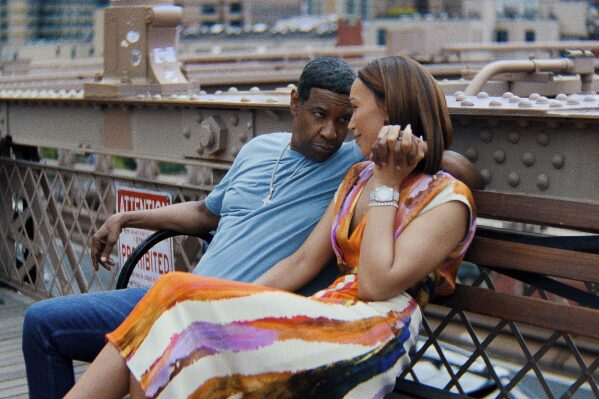
*SPOILERS FOR THE PLOT OF HIGHEST 2 LOWEST*
There’s an electrifying scene in Spike Lee’s latest film Highest 2 Lowest where Denzel Washington is facing off with A$AP Rocky in a recording studio. In this remake of the Akira Kurosawa 1963 classic High and Low, Rocky plays a rapper named Yung Felon who has kidnapped and ransomed a child in music mogul David King’s life for $17.5 million dollars. Denzel plays the mogul King, who’s out for revenge. When Felon finds out his baby mama told King some embarrassing information about him, Felon calls his old lady a “bitch” under his breath. King pipes up:
“Why she gotta be a bitch?”
“Why she gotta be a bitch?”
“Why she gotta be a bitch?”
We don’t know if King actually repeats the question three times; it’s a Spike Lee tic where lines of dialogue or action repeat in quick and sometimes overlapping succession. And Felon neither answers nor acknowledges the question(s). But this extra emphasis in the final edit is practically begging for the audience to acknowledge that at least he asked!
This is the extent of Spike Lee’s feminism.
Though I reviewed the film more fully for Contraband Camp where I didn’t mention this scene, I might’ve let Lee’s refusal to engage with past critique about his portrayal of women go if not for this one, repeated, infuriating line of faux depth.
Incredibly—in a film centered around the toxicity of the music industry in late stage capitalism, and an aging, out-of-touch patriarch who’s nicknamed King David — Spike Lee doesn’t swim a drop deeper than that.
At the beginning of the film, when King shares that he’s lost his passion for the music business, it’s because of the rise of A.I. and the “attention economy” that’s obscuring the “real music” he longs for. He’s certainly not crying or reflecting over his role as a pusher of the rampant misogyny in hip-hop. Seriously, how many times was King in the studio, on the other side of that producer’s glass, listening to his artists spout misogyny without blinking? We can safely bet King’s interaction with Yung Felon where he’s trying to son and one-up the man who took everything from him was King’s first and last time objecting to the word “bitch” coming out of a rapper’s mouth.
In fact, instead of any analysis on colorism, sexism and ageism in the music industry in this post-#MeToo era, Lee simply perpetuates all of these things with his paper-bag test visual language.
As I mentioned on Contraband Camp, every woman who is supposed to be viewed positively—as beautiful, as talented, as desirable—is biracial or Latina. Light-skinned women surround King at home, at the gates of his office and even inside it. Faceless, G-stringed, BBL’d asses bounce up and down beside and behind Yung Felon in an imaginative rap performance for the King.
Where brown men from King to his son Trey to his main opp Yung Felon abound on screen, Lee fills out scenes with light-skinned background women like real-life celebrities Ice Spice and Princess Nokia to solidify King and his record label as the center of culture. The only dark-skinned woman character in the film is a cop who unironically touts Spelman College and “Black woman excellence” while working for the loathsome NYPD.
But Lee gets the colorism, ageism, sexism trifecta in his casting of the main woman “lead.”
Want Gina from Martin to play Denzel’s wife? Don’t call the original and age-appropriate Tisha Campbell, who would’ve looked just as gorgeous and had better chemistry with the star; cast the lookalike who is 30 years younger than Denzel, give them a 17-year-old son, and pray the audience can’t add or subtract.
If Ilfenesh Hadera who plays Pam King could act, I would’ve still talked shit might have let this slide too. Instead, when her character gets the news that Yung Felon has kidnapped their son Trey, she reacts like her card just declined at Tiffany’s. Maybe it’s for the best, then, that Lee and screenwriter Alan Fox stripped her character of her role as the emotional core of the Kurosawa original.

In High and Low, when a poor man kidnaps a wealthy man’s chauffeur’s son by mistake, the wealthy man’s wife begged her husband to pay the ransom anyway and save the chauffeur’s son, even if it meant a life of poverty that she had never known. In Highest 2 Lowest, however, when Mrs. King finds out that it wasn’t her son after all but the chauffeur’s son that’s been kidnapped, her response to potential poverty is essentially “fuck that kid.” That could have been an interesting twist on the character—not your typical, soft-hearted wife, but the ruthless, capitalist, #BlackExcellence queen who feels entitled to her throne, even if it costs a child his life.
But Lee refuses to tell us anything substantive about her character or commit to making the rich people the real villains, even as they contemplate letting their “godson” die. Lee is, after all, a very rich person. An anti-capitalist manifesto this is not. And thinly written light-skinned women are par for the course in a Spike Lee Joint.
The epilogue of the film sees King leave his long-time, toxic, corporatized, soulless, capitalistic music label behind and start something new, something authentic. And which artist does he use as the launching pad for his revolutionary new start? An up-and-coming Doechii? The next Lauryn Hill? An undiscovered Amber Riley? An emerging Jill Scott? Surprise! It’s the same kind of Ice Spice and Princess Nokia artist that surrounded him at his old label: young, skinny, extremely light-skinned, and scantily clad. His son Trey literally touts the new artist to King by describing her as “a more-light-skinneded-ed Zendaya.” Be so fucking for real.
I refuse to believe this is unintentional.
During the production of Lee’s 1988 film School Daze, which didn’t “tackle” colorism as much as it perpetuated its existence on screen, the aforementioned diva and star of the film Tisha Campbell recently shared that Lee also treated the light-skinned actresses better than the dark-skinned actresses behind the scenes. Beyond giving the light-skinned girls the name “wannabes” and the dark-skinned girls the actual racial slur “jiggaboos” in the script, behind the scenes, Lee put the male actors up in a nice hotel with the light-skinned actresses like Campbell and the dark-skinned actresses in a worse hotel. “It was to create real method chaos, right? It was a social [experiment], absolutely, to create the true tension,” Campell said. “And it worked.” This was colorist violence then and it is now. Lee’s continued unwillingness to differentiate between analyzing colorism and perpetuating it in his filmmaking is a shame.
And Lee has been shamed before.
In 1986, Spike Lee premiered his first film She’s Gotta Have It. Nola Darling is the titular “she,” a Black woman in New York who loves having sex with multiple partners. But the film is told not from her perspective, but from the men’s with whom she has sex. Black feminist icon bell hooks castigated Lee for this in one of the most iconic and necessary reviews of any film, “Whose Pussy Is This?” She writes:
It is the men who speak in She’s Gotta Have It. While Nola appears one-dimensional in perspective and focus, seemingly more concerned about her sexual relationships than about any other aspect of her life, the male characters are multidimensional. They have personalities. Nola has no personality. She is shallow, vacuous, empty. …[Lee’s] imaginative exploration of the [B]lack male psyche is far more probing, far more expansive, and finally much more interesting than his exploration of [B]lack femaleness.
The film is one year younger than I am. This review was published in hooks’ book Reel to Real: Race, Sex and Class at the Movies in 1996. Lee has been pulling these shenanigans for basically the entirety of my life! hooks, God rest her, could’ve written that same review today about Highest 2 Lowest. Imagine how tired we are.
Though Alan Fox’s script is the weakest part, Denzel and Rocky still make a lush playground of their characters while the women don’t exist beyond their roles as accessories for them. Lee is simply uninterested in exploring the Black women characters in this film with any depth. At least this time there’s no pretense: Highest 2 Lowest is after all, a story by men, about men, for men.
But Lee still remembers hooks’ critique decades later.
In 2018, at the press junket for his Oscar-winning copaganda film Blackkklansman, I interviewed Lee about critics—Boots Riley had just come down on him about making a cop the protagonist in a story about the fight against anti-Black racism—and Lee dropped hooks’ name and film review unprompted:
“With every film, it’s something,” Lee told me, not considering Riley’s criticism specifically. “She’s Gotta Have It is ‘misogynist;’ School Daze, I was ‘airing out the dirty laundry;’ Do the Right Thing, ‘Black people are gonna riot;’ Mo’ Better Blues, I’m ‘anti-semitic;’ Jungle Fever, I’m ‘against interracial relationships;’ “bell hooks had an article called, ‘Whose Pussy Is [This]?,’” he laughed, remembering the scathing essay.
But, he still acknowledged that there could be room for growth:
“No one’s going to do any art form that long and there’s not going to be criticism that’s legit,” he said. “So, if the stuff’s legit, you try to reconfigure based on what the criticism is and just keep stepping.”
Lee must’ve found the wide criticism of his past copaganda compelling enough to “reconfigure” Highest 2 Lowest. This is, after all, a remake of one of the most iconic police procedurals. And since it is set all over Lee’s beloved New York City, inevitably, he would feature one of the most loathsome, corrupt and infamous police departments in the country: the NYPD. As I wrote for Contraband Camp, I was nervous about what his portrayal of the NYPD would be going into the film because it was reported in 2018 that Lee was paid over $200,000 for consulting on NYPD community policing ads during the height of the movement for Black lives. But that lambasting Lee got from the Black community in 2018—specifically, from another Black man, Boots Riley—must’ve paid off.
Highest 2 Lowest subverts the police procedural model of the original by making the NYPD little more than racist, classist, incompetent obstacles to progress. In that regard, it’s practically a documentary. Instead of the police being the brilliant detectives they were in the Kurosawa original, King and his chauffeur Paul (an always great Jeffrey Wright) team up to track down Yung Felon. The film’s theme is King’s refrain (and perhaps a mea culpa from Lee on that $200K): “All money ain’t good money.” That is also the extent of Lee’s criticism of capitalism.
There is some good stuff in the film. Denzel is at his best and A$AP Rocky rises to the occasion. Lee’s two gorgeous train set pieces rival Kurosawa’s original. And the chorus of Rocky’s much-played song “Trunks,” in the film, is an earworm. I can’t stop saying “Shout out to my felons / boy we caught another felony!” As I wrote in my review for Contraband Camp: “With flash and thin substance, amazing performances and little to say, Highest 2 Lowest runs the gambit and lands firmly in the middle.” But when it comes to Lee’s portrayal of women, 40 years later, not a thing has changed.
As Bojack Horseman’s grandfather said in one of the best episodes of the eponymous animated Netflix show: “As a modern American man, I am woefully unprepared to manage a woman’s emotions. I was never taught, and I will not learn.”
That is Spike Lee’s legacy too.
Stay Watchin’,
Brooke
***BLACK MEN! If you do want to unlearn patriarchy, Black Girl Watching is hosting a Zoom book reading and discussion of bell hooks’ The Will to Change. SIGN UP HERE!***
Enjoyed this piece? Tip your writer!


Leave a Reply