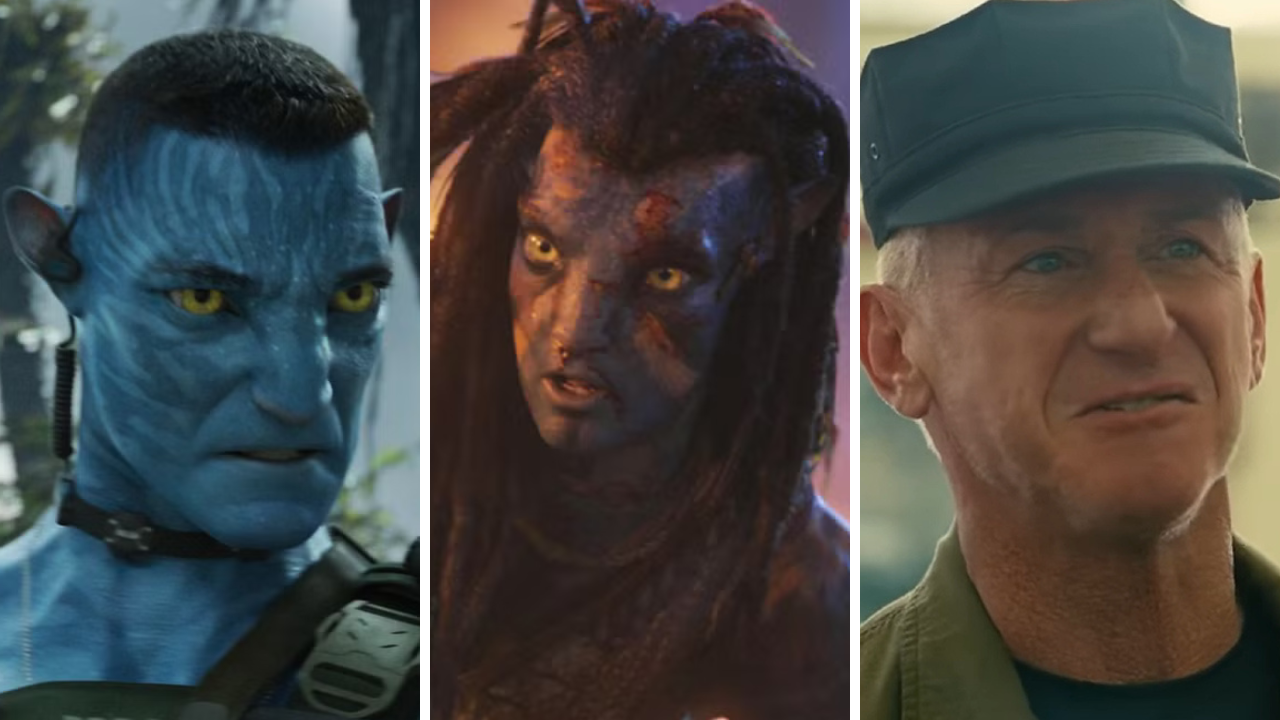
James Cameron would like us all to know that no generative A.I. was used in the making of the third Avatar flick, Avatar: Fire & Ash. A featurette with his special message to the audience played before a screening at the Disney lot that I took my parents to over Thanksgiving. So, don’t worry: the appropriation of African and other Indigenous people, as well as their aesthetics and culture, was all done by real humans, not a bunch of environment-destroying, plagiarizing robots. Phew!
In a world where studios are partnering with A.I. start-ups at the expense of people’s jobs and copyrights to their creative works, this distinction matters. Yet the spiritual difference is slight and par for the course in Cameron’s Avatar franchise. It has always been a colonizer tale where the benevolent white saviors think they’re actually the good guys and not exactly like all the other colonizers. It’s right there in the title. This franchise is about white people cosplaying in an Indigenous body, both on screen and behind the camera. From its very first film—a blatant rip off of the animated classic Fern Gully where a white male logger falls in love with an Indigenous fairy and learns why killing the environment is bad—Cameron puts a disabled white male U.S. marine in a blue alien avatar body and turns him into a hero of Indigenous people.
A World of White Saviors
The white savior in question is named Jake Sully, played by Australian actor Sam Worthington whose commitment to not even trying an American accent is hilarious, considering the whole point of these movies is ripping off other people’s cultures. A former U.S. marine who became disabled while minding Venezuelan people’s business in Venezuela (times never change), Sully is too broke to afford the spinal surgery that will make him walk again. But he is a genetic match for the lab-grown avatar of his dead scientist twin brother (who was killed in a robbery! Irony!) and is thus valuable to the American corporation’s mission to colonize the moon Pandora and control its Indigenous population and resources. And if Sully is successful, he will get his surgery.
The Na’vi are a tall, blue feline species indigenous to Pandora. These African-coded aliens rock cornrows, beads, locs and even boho passion twists depending on the region and tribe. They are fierce warriors who have been fighting back to protect their land and their people against the invaders they call the sky people, which is genuinely too kind of a term for the genocidal freaks who have come to destroy their planet. Cameron swears he got the idea of blue humanoid aliens in a dream that he had. We don’t believe you. But with how much Avatar rips off actual African people and white imperialist history around the world, it seems more likely that Cameron just tapped into his ancestral memories.

The Na’vi can recognize a sky person in an avatar based on their five-fingered hands—as compared to the Na’vi’s four fingers. But the saving grace for the Na’vi is that human invaders can’t breathe the air on Pandora without a mask or without being in their avatars, which prevents the invaders from taking over Pandora in larger numbers. This built-in defense mechanism, however, becomes jeopardized in Fire & Ash due to the Na’vi’s consistently ignorant choices to welcome colonizers into their communities with open arms.
Led by U.S. marine Col. Miles Quaritch, the invaders rob Pandora of its resources—unobtanium in the first film; amrita, which stops human aging, in the second and third films; and the whole planet for earthlings to live on by the end of the trilogy. Sully is Cameron’s self-insert who lives up to the key tenant of being a white savior: he’s not like the other guys! Sure, he willingly joined the Let’s Colonize Pandora mission alongside other mercenaries like Michelle Rodriguez’s character, and the group of sociopathic scientists who use avatar bodies to study the Na’vi in order to feed information back to the Let’s Colonize Pandora mission, but they feel bad about it, and that’s what counts!
“I didn’t sign up for this,” Rodriguez’s character says in the first film as she flies her armed military helicopter away from the Armed Military Helicopters Genocide the Na’vi portion of the mission. Babe, yes, you literally signed up for this. Yet in each film, there’s always a group of “good white people,” scientists or mercenaries, who decide to work together against the American corporation that they voluntarily traveled years away from Earth to join. This about-face happens after, of course, helping the mercenaries get all the information that they needed to attack the Na’vi in the first place.
The Demonizing of Resistance
Still, the defectors are seen as brave and good, and the Na’vi are so grateful that they let Sully and the other white defectors into their most sacred traditions, like blessing Sigourney Weaver’s scientist character with access to their sacred tree, because Sully asked them to and they believe Sully was chosen by their god Ewa to lead them as Toruk Makto, an honorific for only the fiercest chosen warriors. This is Cameron’s most insidious act: turning the Indigenous god against them to anoint their oppressor.
At every turn, when the Na’vi would defend themselves against the death and destruction white people bring, “Ewa” sends them little signs saying “don’t kill these white people.” Ewa intervenes twice in the first film for Sully and it’s boring and predictable. Every colonial story features an Indigenous god choosing the white man that’s colonizing them to lead them. And lead them, Sully does, with his mercenary-issued machine gun—even though it’s against the customs of the Na’vi to use the metal weapons of the sky people.
Though Sully has married the chief’s daughter Neytiri (played by Zoe Saldaña), the spiritual leader of the Na’vi tribe he infiltrated in the first film, he is, as he said in that film, still a marine. “You may be out, but you never lose the attitude,” he said and continues to prove. The blue alien body that the Na’vi infused his brain into in a ceremony solidifying him as “one of them,” does not change that. He thinks like a white colonialist trained by the U.S. military, and that’s how he raises the three half-avatar, half-Na’vi children he has with Neytiri.
The child actors who play Sully and Neytiri’s children are also white—despite their characters’ African-coded locs, cornrows and beaded braid hairstyles. Their adopted virgin-birth-born daughter Kiri, the product of Sigourney Weaver’s comatose avatar from the first movie and Ewa’s “blessing,” is also played by 76-year-old Weaver who tries very hard to sound like a teenager. The last kid is Spider, the fully white human son of Quaritch, who paints himself blue. If it’s not appropriation at every level, James Cameron doesn’t want it!
“Sullys stick together” is the family motto with which Sully indoctrinates the children, because, at the end of the day, the white nuclear family is what Sully knows. Despite the fact that this is against everything Neytiri has been raised to believe in her Indigenous community where even trees and roots and rocks are family, she goes along with it, taking their nuclear family on the run from Sully’s comrades-turned-enemies. Because of Sully, all the Na’vi are consistently in danger.
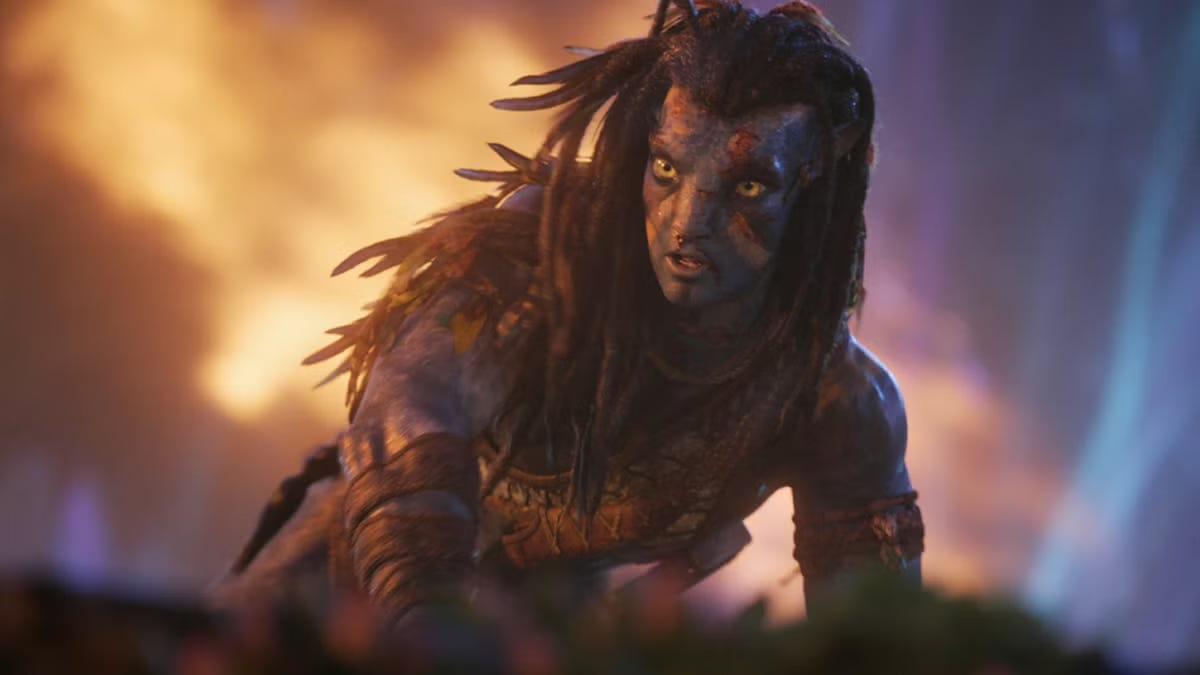
Like a scorned lover, Quaritch chases Sully across all three movies for daring to betray him and join up with the Na’vi. No matter that the real Quaritch is dead, killed by Neytiri in the first movie. His memories before his death were uploaded into an avatar. The villain is literally a sentient ChatBot. Why should we take this seriously? They weren’t even friends, there is no justification for Quaritch to be this pressed except for “the title of this movie is Avatar” so the dude with the avatar has to be the center.
But all of the white characters have an inexplicable sense of importance in this narrative. Sully’s youngest half-avatar, half-Na’vi son Lo’ak, the black sheep compared to the oldest boy, is so bonded with Quaritch’s white son Spider who has been raised among the Na’vi, that Lo’ak risks his older brother’s life to save Spider. Predictably, the white boy is saved and the oldest son dies in his place.
“A son for a son,” Sully says in an outrageous scene as he embraces Quaritch’s son and hovers over the lifeless body of his own. Mind you, for the entire second movie, Spider has helped Quaritch learn Na’vi ways, speak Na’vi language and even translates for him as he threatens the Na’vi while looking for Sully. The Na’vi are consistently expendable in the place of the white heroes, whether Sully or Spider or, worst of all, even the villain himself.
When Quaritch was near death at the end of the second film, who stepped in to save him? Spider. He knew the monster that Quaritch was. He knew the danger that he posed to the Na’vi. How many Na’vi have been killed over three movies because of Quaritch and Spider? Immeasurable. Supposedly, the Na’vi are Spider’s “family,” but Quaritch is his father. That nuclear family thinking will always matter most. It’s insanity for Sully to embrace this walking threat to the Na’vi as his own family until you remember that embracing white threats to Indigenous life is what these movies are all about. Also, obviously, Sully is a white man inside of a blue body. Just like Spider, when it comes down to it, white folks “stick together” too.
By the third film, Neytiri is the only one bitter about this. She blames Spider for her son’s death instead of blaming herself for falling in love with the sky person who betrayed her people, like that Disneyfied caricature of Pocahontas. When she pronounces her hatred for Spider and all sky people, Sully tries to chastise for it. “Do you hate me and your children too?” He scolds her and the answer should probably be yes. He is literally the reason for all of her people’s suffering. What he didn’t do directly, he helped the other sky people do by feeding them information, by joining their mission to Pandora in the first place. They have all more than earned her rage.
But Neytiri’s chasting isn’t restricted to the events of the film. Recently, Zoe Saldaña has come under fire during her press run for the movie for calling Neytiri a “racist,” for hating her literal oppressors. Yes, the Zoe Saldaña whose blackface/prosthetic nose performance of Nina Simone in a biopic is a literal hate crime, thinks hating the colonizers who murdered your father, your people and destroyed your forests is racism. The Zoe Saldaña who was dragged to hell by the Nina Simone estate (and everyone else who’s Black American) for this obscene disgrace of a performance and stood on it anyway, only to apologize for it years later during the racial reckoning of 2020 when she first learned that colorism is bad, calls the character she plays—and not the franchise she plays in—racist. Girl.

Anyway, Neytiri is outnumbered; her son Lo’ak, who jeopardized his brother’s life to save Spider isn’t going to start regretting that choice now. And Neytiri’s adopted daughter Kiri is born of a sky person’s avatar and is a total op too, rejoicing over Spider’s rescue more than she mourned her brother’s death at the end of the second film. When Spider’s gas mask breaks in the third film, leaving him in distress and on the brink of death, Kiri uses her powers from Ewa (why did Ewa grant this child of a white woman’s dead avatar magical powers?!) to make it so that Spider is reborn in symbiosis with Pandora’s ecosystem. Now he’s a sky person who can breathe the air. Never mind that if the colonizers get ahold of Spider and recreate his restructured DNA to make it possible for all sky people to breathe Pandora’s air, the Na’vi will be overrun, outnumbered and destroyed for good. Kiri’s in love with Spider, and that matters more. Are you seeing the pattern? When it comes to Indigenous struggle for liberation, romantic love can be used as a weapon to undermine it.
A Different Choice
In yet another example of how Fire & Ash regurgitates every problem of the original film and amplifies it, Spider and Kiri kiss. But the actor who plays Spider is an actual child, and Kiri, you’ll remember, is played by 76-year-old Sigourney Weaver. To avoid an “age-gap kiss,” to put it mildly, Weaver kisses some stand-in when her character is supposed to be kissing Spider, and the child actor kisses someone else age-appropriate, according to Weaver, and they fixed the two characters kissing in post. But why are we here at all? Why hire a 76-year-old woman to voice a teenager, when you could just, you know, hire a teenager? Why hire white people to play African-coded characters and then make them do a funny little accent (Kate Winslet, when you did that stereotypical ululation when your character went into battle, were you not embarrassed?). Why, why, why?
By the events of Fire & Ash, the foolishness of the franchise comes to a head. Seemingly jealous of Sully and the family he’s built among the Na’vi with Quaritch’s own son, Avatar Quaritch finds himself a Na’vi woman and a tribe of his own. Another white woman in Indigenous cosplay, Charlie Chaplin’s granddaughter Oona Chaplin plays an ashy Na’vi and pyromaniac named Varang (something I discovered only upon Googling just now, even though I suffered through this 3.5 hour tedium twice). A mass-murderer of other Na’vi tribes, Varang and her tribe kill for no stated purpose beyond the thrill of the game. She teams up with Quaritch because they match each other’s freak and she’s impressed by his machine guns that make fire. Besides the fact that she hates Ewa for letting her village burn up in a fire as a kid—Ewa really does seem to be on the side of the oppressor, so, fair—there’s absolutely no good reason beyond Quaritch getting her machine guns that she would team up with him or that she was hunting random Na’vi for sport in the first place.
Cameron doesn’t flesh out her character or the tribe that follows her beyond what the plot needs because he is not interested in the Na’vi. He’s interested in his own avatar. Like Paul Thomas Anderson’s exploration of his anti-Black and misogynistic fetishes of Black women in One Battle After Another through the self-inserted characters of the hero Bob and villain Lockjaw, Cameron has also introduced Quaritch as the freaky other side of his hero Sully in Fire & Ash. When Quaritch mates with Varang and later confronts Sully with Varang’s tribe as back up, you can practically hear him paraphrasing One Battle’s Lockjaw: Oh you like blue girls? I LOVE blue girls!

The greatest irony of making Quaritch someone who also seeks community among the Na’vi, is that it merely emphasizes how much Quaritch and Sully (and James Cameron) are the same. They want the culture, the connection, the community that Indigenous people are known to create, but they don’t want to give up the power of their systemic whiteness in order to receive it. Sully has buried his white disabled body in the earth and fully synced with his blue avatar body, but he does not let go of his militaristic mind, the hypermasculine ideals that keep his sons from being close to him, and his paternalistic desire to be the (humble) leader.
Though he chastises Quaritch about not accepting a new way of being, Sully also can’t help but maintain the white supremacist, patriarchal ways of his own indoctrination which are in direct conflict with the matriarchal society of the Na’vi. He’s the liberal to Quaritch’s MAGA, but at their root they are the same. Without surrendering to matriarchy, they will always be destructive to the cultures and the people they claim to admire or even love.
When Quaritch brings his new love interest and her tribe back to the corporate base, the general of the mercenary military mocks them. It’s clear: they can be used, but they will never be accepted by the colonizers. That doesn’t stop either of them from fighting on the colonizers’ team. This could have been a fascinating plot line, exploring tokenism and the ways that white supremacy demands people of color to contort themselves for a crumb of belonging. But that’s not what we’re here to do, and Cameron is the exact wrong messenger for that story anyway—though clearly that has never stopped him before.
But it’s through Spider in Fire & Ash that Cameron makes his goal of these films most clear: receive access to these communities that he so desires; benefit from them; give back far less than you receive; and remain fundamentally unchanged.
The undercarriage of Spider’s nasty-work “dreadlock” wig now contains the same connector to Ewa that the Na’vi were born with. This means he can also access the spirit realm where all the ancestors of the Na’vi rest. And so, in the final scene, he does. Kiri’s mother, also played by Weaver, is there, raising the white population in the spirit world to two. And all the ancestor Na’vi, including those who died in his place, reach their hands out to anoint Spider as a member of their tribe, mirroring the scene from Sinners of vampire Remmick, encircled by the undead Black musicians whose souls he stole, soaking up their magic, soaking up their power, bringing them eternal death in return. Despite the damage that Spider has done and could do to the future of the planet, he wants what he wants: access to the club. And the stereotypical, good-natured, magical Indigenous folks exist to grant him his wish. This is the culmination of a colonizer’s wet dream. Let Kiri tell it, Ewa has willed it.

Cameron has undeniably contributed technological advancements to the craft of filmmaking through this franchise. But craft always begins with story. He could have made a Na’vi franchise, focused on Indigenous resistance to American imperialism. He could have hired marginalized co-writers instead, if he was so pressed to write it, and cast actual marginalized people to play all of the Na’vi. He could have centered their stories and made them their own saviors. If he wanted so badly to center himself, he could have based the Na’vi on his own Scottish ancestors and their struggle against English invasion and the white supremacy that has choked out European ethnic identities and cultures to solidify a homogenous power over people of color.
But it’s way more comfortable to maintain the status quo and be the center of Indigenous struggle, instead, I guess. As a result, his franchise simply perpetuates the colonialism, destruction, and counter-revolution that he pretends to critique. And that makes Cameron his franchise’s own worst enemy and its true villain.
Sure, he’s made $6 billion dollars and counting from this project that’s taken him 20 years to produce, but the only conversation around this best-selling movie series of all time is about Saldaña being a clueless shill for white supremacy again. The 3-D experience may keep theaters going another month in the Hollywood hellscape that studio executives and tech overlords have wrought, but it’s like a trip through a fun house mirror. You go in, you see your warped reflection, you leave, and you never think of it again.
Since 2009, Avatar’s lack of quotable lines and cultural impact have dogged the franchise. It doesn’t move the girls, it doesn’t move the gays, and it doesn’t move the Black people who sit at those intersections and make the Culture that’s being appropriated in the first place.
Because just like the Na’vi, the Culture can spot a lifeless, soulless, empty-suited, five-fingered fake from a mile away.
Stay watchin’,
Brooke


Leave a Reply