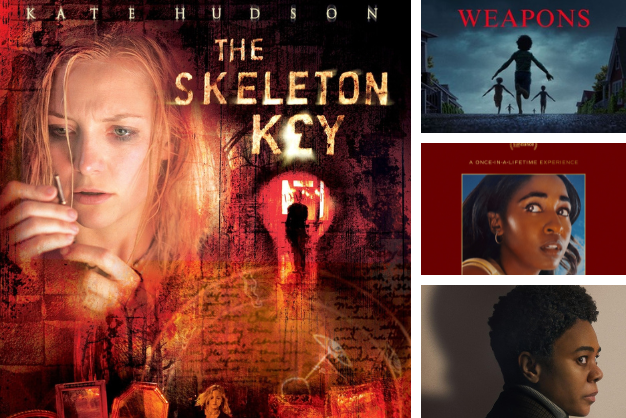
This Spooky Season, I’ve been revisiting some old favorites (Death Becomes Her is still perfect, The Mummy is incredibly racist to the point of being unwatchable and what is up with Rachel Weiss’s eyebrows?? Someone should pay.). I’ve also finally watched some horror movies I’ve been hearing about—Weapons, Opus, and Master. And now, I’ve done it. I’ve found the worst horror movie I’ve ever seen. But first, the others.
Weapons
*Spoilers for Weapons below*
Many people have asked me to watch Weapons. Warner Bros. even offered me tickets to see it in a theater, which I forgot to use. Sorry about that! The hype around this movie—that it’s either comparable to or better than Sinners—absolutely turned me off because it was transparent. People who hated the idea of Sinners’ critical and commercial success have been looking for a savior to champion that would knock Sinners off its throne. First: Weapons is the best horror movie of the year! Then: One Flop After Another is the masterpiece of the year! It all felt reminiscent of when racists hyped up Rocky because they were tired of Black boxers dominating the sport in real life. So, anyway, I watched Weapons.
A classroom full of students at an elementary school in a sleepy, majority-white town in suburbia disappears except for one boy. The town is horrified, the classroom teacher is harassed and bullied and the police are clueless and helpless to find the missing kids who all got up at 2:17 A.M. and ran out of their front doors, arms in a V-shape at their side, like some freaky little scissor people. I’m not going to spend too much time on this, because I don’t think the writer-director spent too much time on it either, but essentially, the sole boy who didn’t disappear has a parasite in his house, Aunt Gladys, who is decaying and needs the life-source of other people to keep going. She’s taken over the boy’s parents, but it’s not enough, so she gets the boy to bring a token from each of his classmates home. She does a spell and all the kids run out of their homes and into his basement where Gladys can feed off of their life source. The boy is responsible for keeping the zombified bodies of the other kids and his parents alive by feeding them soup. But I was told this was comparable to or better than Sinners, so I was looking for some depth, some meaning, some healing.
It’s maybe, partially an allegory for the impact of addiction; Barbarian writer-director Zach Cregger has talked about being the child of an alcoholic and dealing with addiction himself. Every adult character in the film has some sort of addiction, including the teacher, who has an alcohol dependency and a DUI, but loves her students. Like Gladys’ spells, addiction can take ahold of anyone and destroy whole communities. The parentification of children that happens when they live with an adult with addiction can be horrifying, isolating and unjust. The boy feeding his parents soup is a heartbreaking image in that context.
Like Ryan Coogler, who wrote Sinners to heal after the death of his great uncle to whom he never got to say goodbye, Cregger wrote Weapons after the death of a good friend with an addiction. That’s about where the comparisons between the films should end. There’s no healing in Cregger’s story of addiction. The little boy defeats Gladys by using his classmates as his own weapons, which both frees them all and further traumatizes them, as they’re now violent killers, and so is he. His parents wind up in a mental institution, seemingly for good; the children remain mostly zombies who’ll likely go on to traumatize other people if they ever recover; the only gay couple in the movie is violently killed, and then the movie ends.
“I don’t care if any of this stuff comes through, the alcoholic metaphor is not important to me,” Cregger told The Hollywood Reporter. I can tell. It’s a horror-comedy about a witch who needs children to live. We should leave it at that.
Opus / Master
Ayo Edebiri stars in Opus and Regina Hall stars in Master both movies about the dangers of being the only Black person in a white space. Ayo is a journalist investigating a cult led by a canceled rock star. Regina is a professor and the new master of an Ivy league dorm haunted by its ties to slavery. Master isn’t all bad—it doesn’t stick the landing, but it is a good warning for those who believe ascending to the heights of these anti-Black institutions (that were literally built on slavery) will be worth what it costs of your humanity to climb. There’s also a Rachel Dolezal dig that I could not stop laughing at, but I’m not 100% sure it was intentional. But Opus is just digital tape and runtime. It’s not particularly scary or interesting, it offers nothing new to say about cults, or vanity journalism as a tool for propaganda, and worse, it says that nothing in an uncompelling way. It’s just a movie that I watched over the summer and immediately forgot until this moment.
The worst horror movie I’ve ever seen: The Skeleton Key
*Spoilers for the plot of The Skeleton Key*
I’d heard in the background of my life that there was a horror movie about an Ivy League fraternity with secret ties to slavery and enslaved ghosts come back to life and get revenge. I thought that’s what The Skeleton Key was about. Apparently, my young mind had combined the plot of The Skeleton Key with a thriller from 2000, The Skulls (the Jonathan Jackson Yale illuminati movie that Roger Ebert called “one of the great howlers”: “It isn’t a comedy, but that won’t stop anyone.” Man! I miss Ebert.). The movie in my mind was way better than them both, but The Skulls is bad in all the typical Hollywood liberal ways. The Skeleton Key is something worse. Its 37% Rotten Tomatoes score doesn’t begin to scratch the surface.
When I call it the worst horror movie, I don’t mean that there aren’t jump-scares that might catch you or horror elements that are unsuccessful. I don’t just mean that the plodding plot and rampant stereotypes make it a slog—though that is true. I mean that this script and casting are so devious and underhanded in its anti-Blackness as to be infuriating. But let’s start from the beginning.
Kate Hudson stars as an hospice nurse who wasn’t there for her own father’s death and now must treat every patient as if they were a second chance with her father. She lives in New Orleans with her Black Best FriendTM who exists only to correctly identify the weird African American Goings-OnTM at Kate’s new job on a plantation as a live-in nurse to an old white man who’s had a stroke and can’t speak or control his body. His rude, overbearing wife and the villain of this tale is played by The Notebook’s Gena Rowlands. And while Kate is most certainly going to jail for this role, I may never forgive Gena either. The old couple’s estate attorney convinces Kate to take the job, after unpleasantries with Gena.
But Kate becomes suspicious of Gena when the old man begs Kate to help him and tries to escape the house during a rainstorm. She goes investigating in the plantation house and finds a room in the attic, opened by a skeleton key, that’s full of mirrors and other Scary Black Things. Joy Bryant plays the BBF and she teaches Kate that the room in the old couple’s plantation house is where Hoodoo is practiced. She even takes Kate to a local Hoodoo shop to get more information, but Joy, the only Black person in the main cast, is too afraid of the Hoodoo her grandmother practiced to go inside the shop or “mess with it”. She encourages Kate to leave it alone. Which of course, Kate does not!
To summarize the summary, we have a story about a plantation house and the Black American closed practice of Hoodoo told from the lens of a white woman main character and a mostly white cast. But it gets worse. Kate believes that Hoodoo is the root cause of her patient’s inability to speak or move and therefore believes if she can learn the right spells, her patient will be cured. She goes back to the Hoodoo shop and BLACK WOMEN TEACH KATE HUDSON HOODOO. I almost turned the TV off.
But I soldiered on, not knowing the horror that awaited. Obviously, because it’s a Louisiana Plantation House, it is haunted by ghosts of Black people. But The Skeleton Key adds a twist. The Black couple who lived and worked in this house came after slavery. They were celebrated Hoodoo practitioners in their community but still needed to work for the mean white people who owned the plantation. Legend has it that, during a dinner party for the new-era enslavers, the Black couple were upstairs in the attic teaching the enslavers’ children about Hoodoo. The enslavers and their guests caught the Black couple and lynched them out in front of the house. The powerful spells Kate needs to learn to save her patient are from the notes and recordings of the Black couple. When Gena “finds out” what Kate is up too, Kate starts using Hoodoo to protect herself from Gena. And Gena fights back with stronger Hoodoo. Yes, these two white women are fighting each other with Hoodoo in a plantation house. I hate everyone involved.
When I said on Threads that I hated this movie, a few people encouraged me to keep watching to the end, “wait for the twist!”
Dear readers, the final twist is a knife: Gena is not Gena at all, she’s possessed by the spirit of the Black woman in the Hoodoo couple. Gena’s paralyzed husband used to be possessed by the Black Hoodoo man but he transferred his spirit into the white estate attorney who convinced Kate to take the job, leaving the old white man paralyzed as if from a stroke. The attorney needed Kate to come work at the house so that Gena can transfer into Kate’s body next and the couple can stay young and keep living in the house for another generation. This means that the Black Hoodoo couple were not the ones lynched by the white mob. They had brought the white children up into the attic not to teach them Hoodoo but with the intention of transferring their souls into the white children.
So the white mob lynched the bodies of the Black couple and the souls of the white children. Could this have been profound? That under white supremacy, the sins of the parents reverberate through time upon the white children’s children’s children? Perhaps in someone else’s hands.
But this story is in the hands of white screenwriter Ehren Kruger and white UK director Iain Softley. And the story they wanted to tell was a story of Black revenge against white supremacy—without any Black people in the roles. Because, in fact, this isn’t a story of “Black” revenge, it’s a perfect metaphor for what happens when deep-seated white guilt meets deep-seated white fear of repercussions.

The Skeleton Key unveils a pathology the likes of which I had yet to see manifest on screen: One day, The Blacks are gonna have their revenge, and when they do, they’re going to replace us! This fear is literally the reason why Hoodoo and other African-rooted religious traditions were banned on this land during slavery and continue to be demonized by the Christian church—and hell, Hollywood too—today.
I’m not saying all Black people are saints, but for better or worse, there’s a reason that the old saying goes: “white people ought to be glad Black people only want equality and not revenge.” History has shown that, time and again, all Black people have wanted en masse in this country is to be left alone; for the obstacles put in our path via slavery and Jim Crow to be moved out of the way; to have the right of self-determination. Immediately after Emancipation, during the Reconstruction Era, Black people who were able to, went to school to be educated, became members of congress, built their own cities and towns and had their own banks, grocers and medical practices. No Black people en masse were hunting down white people and burning their shit down as reparations for slavery. No one was dragging white people out of their plantation homes and trying to sit up in the big house themselves.
But white people certainly burned down entire thriving Black communities in Rosewood and Tulsa, Springfield and Chicago, Wilmington and Thibodaux, from the late 1800s up through the 1960s. White people certainly raided and massacred the Black town of Oscarville in Georgia, and drowned it to build Lake Lanier. White people certainly bulldozed Seneca Village in Manhattan and turned it into Central Park, and overpriced nearby housing to such a degree that the vast majority of Black people can’t afford to live near it to this day. When Black people started gaining economic empowerment by selling the cheap and easy crop of watermelon, white people certainly made a commercial industry out of mocking Black people and watermelons to the point where there are Black people today who won’t eat the fruit in front of white people, let alone grow it and sell it. White American history offers an unlimited reserve of horror stories for white people to mine. But they want to tell their stories and ours to, and make themselves the center of our stories. It’s giving obsession.
I think about what it could’ve meant in the ‘90s for Joy Bryant’s character to have been centered. Disconnected from her grandmother’s ancestral tradition of Hoodoo, to have reclaimed that tradition and used that power for her own healing, her own salvation and that of the lynched Black couple could’ve been powerful.
To write instead two grown Black adults with the ancestral connection and power of Hoodoo as people who would choose to live as white children, growing up to inherit a plantation, and willingly inhabiting the bodies of all the white people who own that plantation (six in total by the end of the film when Kate succumbs to Gena’s evil Hoodoo) is sick. It’s ignorant. It’s racist. To make the real victims of The Skeleton Key— of this barbaric system of racism—all the innocent white people like Kate and the old man and the children, while the real villains are the evil Black couple and their Hoodoo magic…it’s nasty work.
Kruger went on to menace the world again with his screenplay adaptation of Ghost in the Shell, a story about a Japanese woman that’s played by Scarlett Johansen. He also won a Razzie for Worst Screenplay for the wrong movie: Transformers. But the horror that is The Skeleton Key is what should haunt him forever.
Stay watchin’,
Brooke
Liked this piece? Tip your writer!


Leave a Reply