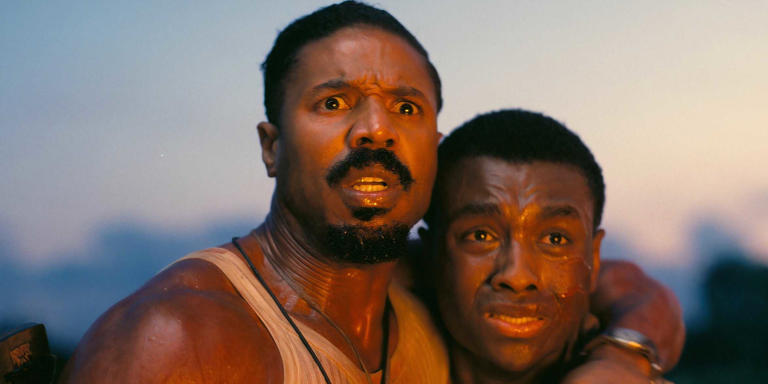
For the past two delicious weeks, there’s been little else on my mind besides the full course meal that is Sinners. I’ve now seen it seven(!!!) times, written a deep-dive, taken different friends to see it, and had the most enlivening conversations about it.
Out of all of the best and worst analyses that I’ve seen so far, the most confusing has been the idea that some Black people don’t want to see a movie set in the Jim Crow South because they don’t want to see any more “slave movies.”
Never mind that Sinners is set in 1932 Mississippi—about 67 years after the Emancipation Proclamation and the end of the civil war. Though I’m certain a lot of these folks got their history tests and English essays returned to them face down in school, I still won’t fault people for accusing Ryan Coogler’s best film yet—and one of the greatest films of all time—of being a “slave movie.” Through Miles Caton’s character Sammie and Omar Benson Miller’s character Cornbread, we see what life was like for Black sharecroppers picking cotton in the Mississippi Delta. Through Del Roy Lindo’s character of Delta Slim, we see how the Black Codes—which restricted Black people’s newfound “freedom” by policing and criminalizing their activities after slavery—led to Black men being imprisoned for the smallest things like “vagrancy” and being forced to work on chain gangs to give the state the free labor they’d lost when the south lost the civil war.
Just as it traces the history of music through the blues—from R&B to country to folk to hip hop to house—Sinners also traces the evolution of slavery. Both sharecropping and chain gangs were the next iterations of the violent institution, and both did their part to keep Black people in America from freedom. The reason Michael B. Jordan’s twin characters Smoke and Stack were underwater financially on the opening night of their juke joint, Club Juke, was because the Black sharecroppers who came to party were paying with wooden nickels—currency that they could only spend at the general store of the plantations that they worked on.
Yes, even in the 1900s, up through the middle of the century, Black people were still trapped on plantations, picking cotton. And for all the audience hand-wringing about not wanting to see “slave movies,” most commenters didn’t know that fact. They’d never heard of wooden nickels. They know nothing of Reconstruction or the Black Codes. And that’s the point.
At the announcement of any new movie even tangentially related to Black enslaved people in America, the online groans from Black audiences are nearly audible. While most people would be hard-pressed to name more than 10 actual “slave movies” in the past 50 years, “I’m tired of ‘slave movies’” is a frequent social media refrain. Still, usually, there’s a good reason.
Typically, in the “slave movie” genre, enslaved Africans in America are central to the plot, or at least the backdrop of the story, and often face extreme violence. There’s often copious use of “n****r” and other racist slurs, as well as the prominence of a white savior for white liberals in the audience to project their fantasies on to of how they would’ve behaved “back then.” (Hint: whatever you’re doing now is what you would’ve done then.) The purpose of these films is to inform audiences about the horrors of chattel slavery while also, weirdly, occupying that entertainment space. It’s a complicated dichotomy. It’s exhausting and, for many Black audience members, traumatic.
But the problem with these films is not that stories of enslaved Africans are being told on-screen. Often, it’s about which stories are being told, who is telling them, how they’re telling them, and why.
The films in the genre that Hollywood studio heads and financiers usually green-light and champion are the ones that eroticize stories of Black enslavement and promote white savior narratives. The last corporate-approved addition to the genre is 2020’s Antebellum, a film so masturbatory in its commitment to eroticized Black trauma that its co-directors and writers, Gerard Bush and Christopher Renz, put Quentin Tarantino and Django Unchained to shame.
Starring Janelle Monaé, Lionsgate’s Antebellum rips off the premise of Octavia Butler’s brilliant novel Kindred but doesn’t even have the guts or the skill to follow through on Butler’s inventive explanation for why a modern-day Black woman finds herself back in antebellum slavery. Instead, the audience is subjected to brutal and gratuitous rape scenes and other horrific violence, mainly against Black women, until an enraging, underdeveloped plot twist appears.
Aggressive in its pointless cruelty to its Black women characters, Antebellum underscores how dangerous it can be when men tell Black women’s stories.
We’ve seen this before.
In Steve McQueen’s Oscar-winning 12 Years a Slave, the true story of Solomon Northup features directorial choices that gratuitously and heinously zero in on the repeated rape of Patsey (Lupita Nyong’o) who is then, separately, whipped by Northup. The excuse of the story’s historical accuracy still doesn’t answer the most important question: Why? Why tell this story of a Black man who is forced into slavery and whips a Black woman nearly to death and then leaves her behind when his white boss finally comes down south to rescue him? Why do we need to see that story on-screen?
Some say we need to educate viewers who don’t know the truth about slavery. But where does education stop and eroticized Black trauma begin?
In the 2016 film The Birth of a Nation, about enslaved revolutionary Nat Turner, writer and director Nate Parker invented a gang rape of Turner’s wife that did not exist in her story. That film flopped, as gang rape allegations from 1999 against Parker and his co-writer Jean Celestin resurfaced during the press tour, raising even more questions about the irresponsible use of sexual assault in the film. Even Kasi Lemmons’ 2019 Harriet refuses to avoid gratuitous violence against Black women. Here again, Monaé stars as a fictional Black woman whose sole invented purpose is to die violently on-screen at the hands of a fictional Black man bounty hunter.
Even as Lemmons chose not to focus on the most brutal elements of slavery in the film, one still must contend with the emotional violence of fabricating the vast majority of Harriet Tubman’s narrative, as if to say her truth was not good enough; deifying Tubman instead of spotlighting her humanity; and skipping over her White enslavers and hunters to create a Black man villain who never existed in her story.
Though it can be of small comfort, at least when Black filmmakers tell these stories, Black people are the main characters.
When white storytellers have full rein to tell our histories, we’re assumed lucky to be the vehicles whom the white savior characters drive to glory. White filmmakers who are obsessed with telling stories of anti-Black racism curiously never want to deconstruct their own. That’s because the white savior’s role in a “slave movie” is not to examine or indict whiteness as a power structure. Their role is to redeem whiteness as a social construct and to protect the fragility of the white audience. Which is why “slave movies” with white saviors, like Django Unchained, Glory, and Lincoln, are so useless to activate any measure of real social progress in the present day.
The 1997 film Amistad had the potential to both educate audiences on the 1839 rebellion of kidnapped Africans on the slave ship La Amistad and inspire rebellions in the present day. Instead, Steven Spielberg’s film continued the genre’s pattern of white savior uselessness by focusing on the white lawyers battling in an American courtroom over whether the rebels were kidnapped people acting in self-defense or if they were property.
The choice to tell this story and tout its “truthfulness” only serves to underscore the “goodness” of whiteness and the legal system it created—the very same system that had legalized slavery in the first place—as well as to normalize the conditional nature of Black humanity.
We can and must do better than this.
At its best, a full-bodied film told from the perspective of enslaved people and centering on Black people processing, surviving, and overcoming trauma — instead of fetishizing Black trauma — could spark more than just another tired and fruitless conversation with white America. It could educate its audience on the foundations of every facet of modern American life and inspire a path forward in the present day with intent to dismantle these continuing systems of oppression.
When Alex Haley’s Roots miniseries came to television in 1977, it was the most thorough and most thoughtful depiction of West African life before, during, and after being enslaved in America. Though largely fictional, the series centered its Black characters, their humanity, their culture, and their resistance to white supremacy over generations. Roots disproved the lie that Black life begins and ends with slavery and inspired generations of Black people to learn their family histories, reject white supremacist narratives, and reconnect to Africa.
We’ve also seen the evidence of dramatization bringing about swift social change in Ava DuVernay’s 2019 miniseries, When They See Us. In the first weekend after the critically acclaimed series told the 1989 story of the five Black boys falsely accused and wrongfully convicted of a rape in Central Park, a global outcry from audience members resulted in the lead prosecutors in the case being forced out of their prominent and lucrative positions. The series also fanned the flames of the growing police abolition movement, perfectly illustrating how the police, prosecutors, judges, juries, and “the whole damn system is guilty as hell.”
Though the story of the Exonerated Five is traumatic, DuVernay illustrates how writers and directors can process Black trauma on-screen without exploiting or fetishizing it. She achieved this by centering the Black audience — mainly the five boys, now men, who would relive their trauma by watching the series. Even the most painful scenes are imbued with empathy and love for the Black audience. When Black people are the target audience, there’s no desire to rub our faces in our own trauma as one does when the goal is “educating” and “bringing awareness” to white audiences.
We’ve yet to see the full social impact of Coogler’s Sinners beyond its historic box-office wins in these first two weeks in theaters, but we have seen a filmmaker center a Black audience in a Black story that deals with Black trauma and is also triumphant. Because this story is for Black people, Coogler does not indulge in gratuitous images of anti-Black violence. A powerful example of this is in Lindo’s stunning scene of Delta Slim recounting the lynching of his friend Rice. The audience only hears faint audio of the lynching in the background as he tells this story—an incredibly effective bit of sound design that allows us to be in the moment with Delta Slim as he remembers it, without forcing those violent images into our brains. And when the inevitable anti-Black violence does come, the victory, in life and death, is ours. That’s how you tell a satisfying liberation story.
Though it is painfully cis-hetero in its presentation of Black life in a Mississippi Delta blues scene that was historically full of musical Black queer folk, Sinners still achieves its aim to be a balm for the grief of what and who we’ve lost in our quest for freedom, and a thesis on how we pursue it: We may not see freedom in this lifetime, Sinners suggests, but we can fight like hell for it and revel in the moments—whether hours or days—when we feel the most free. This is a story worth the cost to tell it.
And good luck telling an American story without slavery because everything about this American life is rooted in slavery. It is the haint that haunts this country’s past and permeates our present and future.
We don’t have the luxury to be “done with slave stories” when slavery is so clearly not done with us.
When the wildfires raged in California this past January, incarcerated firefighters who have historically been the ones fighting these capitalist-made disasters, were forced to risk their lives for the state for less than $30 a day. In the 2020 pandemic lockdown, our capitalist overlords sent essential workers into a pandemic —and many to their deaths —without even a $15 minimum wage, to save the economy that slavery created and maintains to this day. This is slavery! As homelessness and the cost of rent and basic necessities rise, billionaires and their hangers-on like Gayle King brag about joyriding in space subsidized by our tax dollars. As we beg for free healthcare, our government sends billions of our tax dollars to the zionist state to fund theirs—and to facilitate the genocide of the Palestinian people and their land—all while telling us this is the best our country can do for us.
The powder keg of revolution was struck in the summer of 2020, as millions died of covid and millions more lost their livelihoods. Our political overlords have spent decades protecting corporate interests over people, including granting trillions of dollars in pandemic funds to corporations that pocket the money, firing the employees who were supposed to benefit. In July 2020, 30 million American residents didn’t have enough food to eat as unemployment skyrocketed. When the system of policing murdered George Floyd, the explosion of global uprisings shook the ruling class to its core. White politicians kneeled in kente cloth sashes to get Black folks to stop burning down police precincts and setting cop cars on fire. The entertainment industry posted black squares on Instagram to feign solidarity in order to quiet down the evidence of racism in its institutions. And all the while the ruling class was ramping up the police state so that nothing as effective as the 2020 protests could ever happen again.
Biden declared the Covid pandemic emergency over—not because it was ever actually over; in 2025, more than one thousand people still die every week from COVID! Biden wanted our unemployed asses back in the fields making money for this country at the expense of our own health so we wouldn’t have the time the pandemic lockdown gave us to be out in the streets. And when college protestors encamped at their universities beginning in 2023 to protest the U.S.-Israel genocide of Palestinians and their universities’ roles in funding it, Biden created such a fascist hostile infrastructure to punish them that Trump is merely building upon the foundation democrats have laid, kidnapping and incarcerating international students and the deporting immigrants to concentration camps around this country and in El Salvador.
Today, ICE continues its bipartisan reign of terror, detaining and separating even U.S. citizen children from their families and forcibly sterilizing migrant women with our tax dollars. Just last November California voted AGAINST abolishing the slavery of prison labor. With homelessness being criminalized across the country, and private prisons making a killing selling incarcerated people’s labor to the highest bidder, where do you think we’re all headed if we can’t organize right now to abolish prisons and police?
If ever the moment were ripe for “slave movies”—-let’s reframe this: abolition movies—-that could facilitate an understanding of how slavery has shaped us all in the present day while also providing further impetus for healing and upending these systems of oppression once and for all, it’s now.
As the demonic despot continues his attacks on Black history as “divisive narratives” and “indoctrination,” and Hollywood studio executives eagerly rolled back their black square promises to comply with his anti-DEI orders, it’s no wonder this industry won’t allow an abolitionist genre to live up to its potential and tries to aggressively undermine it when it does. Our history is being erased before we’ve even had the chance to know the half of it. But our ancestors have been silenced long enough, and their stories deserve to be told.
The first long-form story I ever wrote was my debut novel Book of Addis: Cradled Embers, inspired by the revolutionary real life of an enslaved girl Oney Judge, who defied her enslaver, George Washington, and lived to tell her own story. My debut documentary film Abanitu, tells the story of my great-great grandmother Lucy Obie, the first generation of our family out of slavery, who bought land to farm in 1906 that five generations of Obies have expanded and continue to steward 119 years later. Facing my past and studying our ancestral history of survival has prepared and empowered me for the fascist United States of today.
There are so many more true and revolutionary stories of enslaved Africans in America that deserve wider audiences — like and Mum Bett and William Dorsey Swann (the first known drag queen!). There are so many reimagined stories on the evolution and impact of slavery like Sinners left to tell. (Imagine missing out on the loving miracle that is Sinners!) Our ancestors had keys, life lessons, tactics and skills that we could be using today against an evolving enemy. When we honor our revolutionary history of struggle and survival, trauma and triumph, our ancestors’ stories from the past can be our healing, our power, and our strength in the present.
Shake off the anti-Black shackles that teach us that slavery is our shame to bear. Enslavement is white history. Survival is ours. And liberation in this lifetime is in our future. What more powerful and far-reaching place to tell these stories than on the screen?
Stay watchin’,
Brooke
Enjoyed this piece? Tip your writer!


Leave a Reply