**********Mild spoilers for Your Mother, Your Mother, Your Mother**********
How many mothers is Your Mother, Your Mother, Your Mother about? If you guessed zero, you would be correct! This film is about Your Dad and how hard he has it.
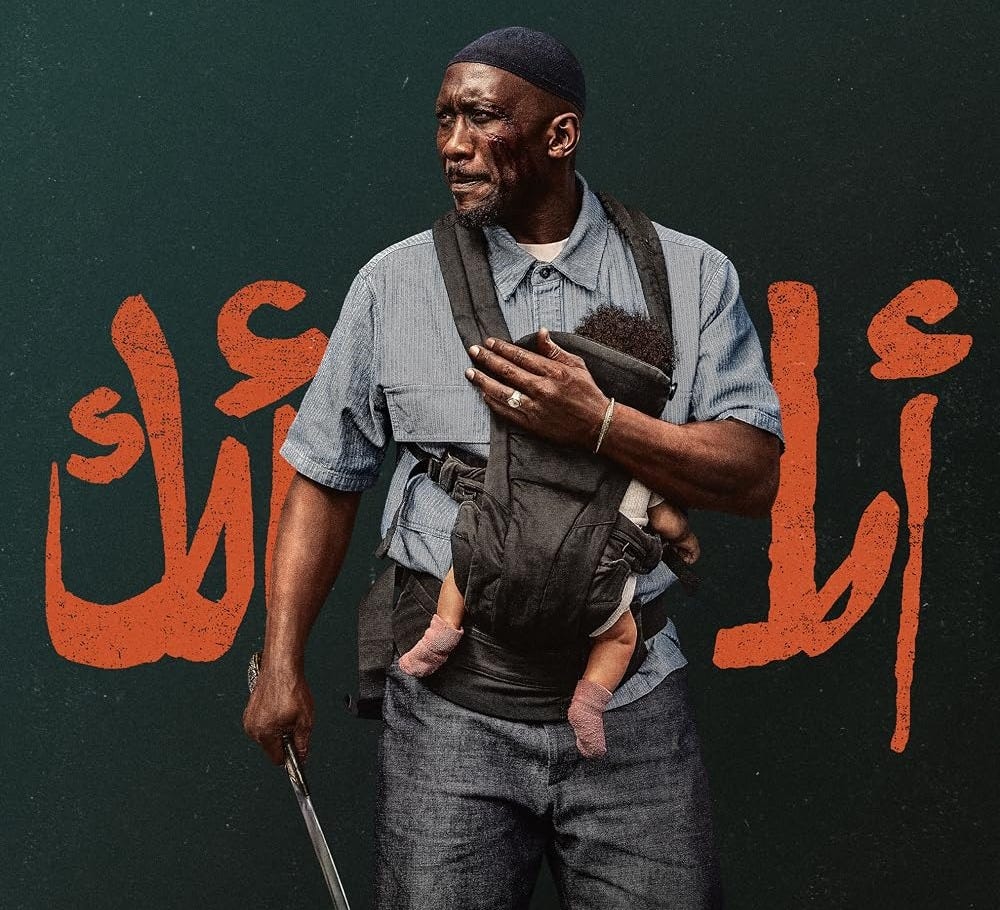
This is first evident in the fact that writer-director Bassam Tariq’s film stars a dad, Mahershala Ali. He plays an assassin named Latif, a devout Muslim who cuts down Islamophobic violent enemies with his swords. On the poster for the film, he is rocking his newborn baby girl in a bjorn to show his nurturing side (#girldad!), while also carrying a sword to show his warrior side. A striking image from the beginning of the film is of Latif practicing sword murder techniques in a way that feels spiritual, meditative, as his young son Qadir swings on a swingset in the background. It’s the clearest image of the film that conveys what’s at its core: wrestling with duty, fatherhood and faith. Your mother is irrelevant.

The mysterious mother of Latif’s three children (including a newborn) dies inconveniently off screen a few minutes into the film while Latif is assassinating a bad man who harmed Muslims. Just as he’s wrapping the body up in plastic, Latif gets a call from his teen daughter Fatiha (played by Adia, a bright spot and rising star) letting him know that her mother is dead, leaving a breastfeeding newborn behind. How did the mother die? Why did she die? When did she die? Where did she die? I’ll spoil it, just this once: we’ll never know.
We only learn that her name was Khadijah when the family’s imam (Giancarlo Esposito) tells a story to Fatiha about why her mother chose the name Khadijah. “I thought you chose it for her,” Fatiha remarks to the imam, speaking volumes of how much this young girl has already ingested about the ways that girls and women are expected to bow to the leadership and authority of men—even over matters of self-identification and governance. “No, she chose it herself!” the imam proclaims proudly while telling her the significance of the name.
Khadijah was the first wife of the Prophet Muhammad. I do not know much about Islam but the vibe I got from the way she is described is similar to the Proverbs 31 woman in Christianity (whom Deesha Philyaw describes as “the Beyoncé of evangelicals” in the first line of her riveting debut novel The True Confessions of First Lady Freeman). Like Khadijah, the Proverbs 31 woman of the Bible was a virtuous and successful businesswoman whom her children and husband revere and for whom her presence is a blessing. As someone whose line name was Proverbs 31, I know intimately the misogynistic burden of this saintly, idealized woman in Christianity who—unlike Khadijah—wasn’t even based on a real woman but still did plenty of damage to real women who were expected to live up to her self-sacrificial standard. Khadijah was the Prophet Muhammad’s first convert to Islam and a major support to his mission. The imam needs Fatiha to know that her mother chose this name—and presumably the holy path of Khadijah—on purpose, for a purpose with which Fatiha should also align herself.
But we don’t see Khadijah choose her own name, or speak at all for herself, so we have to take the man’s word for her reasoning. All that we learn of Latif’s Khadijah is from flashbacks of her in service to Latif. Do we see her face? I don’t remember a clear shot of it, only of her hands, neck, torso—the parts necessary to caress Latif after a long day of killing, or to pray for his safety while he is away committing said killings. A disembodied woman is easy to weaponize and the imam speaks to Fatiha about Khadijah as if setting her up to take on this same role one day: wife of a holy warrior, his first believer, praying and healing his wounds.
Latif also sets his teen daughter up for this role, often leaving his newborn baby in her care as he does some pretty reckless, thoughtless things. The inciting incident that sets our hero on his path to restoring his faith in the wake of his wife’s untimely death is that the newborn won’t drink formula, sparking his desperate search throughout Houston, Texas for breastmilk. He leaves the baby with Fatiha while he does something else, which unintentionally begins the entanglement of him and his children in a holy war with Pastor Hwan (John Cho), an imam-murdering Korean Christian terrorist. This leads me back to my initial conclusion that this is a film about how much harder dads have it than mothers.
Because if Latif’s mysterious wife were still alive, he would’ve never had to have been running around the city trying to find breastmilk and getting into trouble in the first place; the mother would just make the breastmilk naturally. Women famously do not have any problems at all with breastmilk production or babies latching. Surely, the existence of the breastmilk clinic that Latif unsuccessfully tries to obtain breastmilk from only exists for men like him who have no nursing women around to feed babies </sarcasm>.
But on a serious note, yes, sometimes babies prefer breastmilk to formula in real life. Using this as a major plot point in a movie, however, should have a deeper meaning. But the meaning I’m picking up for why Latif chases down breastmilk like an elixir, like it’s ambrosia, feels heavy on the hotep in its symbolism: patriarchal and gender-essentialist in its pedestaling of nursing and motherhood as the ultimate expression of womanhood. Hotep or fauxtep ideology still thinks of women as subservient to men (think: people who say “divine feminine” or call women “womb-man”). But they can glorify cisgender women in their most vulnerable state of pregnancy and nursing because it’s evidence of men’s own fertility and a reinforcement of strict gender roles and responsibilities. It’s out of order for Latif to have to go in search of breastmilk so that’s what sparks all of his bigger problems.
The final straw is when Latif leaves his kids again to go on a risky mission and Fatiha reads to her little brother Qadir a famous hadith (oral history/anecdote) in Islam to comfort him as they worry about if and when their father will return. This is the hadith from which the writer-director Tariq chose the title of the film:
A person came to Messenger of Allah (ﷺ) and asked, “Who among people is most deserving of my fine treatment?” He (ﷺ) said, “Your mother”. He again asked, ‘’Who next?” “Your mother”, the Prophet (ﷺ) replied again. He asked, “Who next?” He (the Prophet (ﷺ)) said again, “Your mother.” He again asked, “Then who?” Thereupon he (ﷺ) said, “Then your father.”
The little brother replies to his sister, “Dang. Dad’s cooked…he has to fill shoes three-times as big—” or something to that effect. And I wanted to pull out my own hair.
Already, this young boy has been conditioned to center a man, even when holy scriptures put three times as much emphasis on a woman.
And I’m not saying that active, present fathers don’t have a hard job; active, present parenting is tough. But most of the hardness of Latif’s job is self-inflicted. He leaves the baby with the teen girl when he should simply be watching the baby himself. When the teen allows a stranger who does sex work to breast feed the baby, he initially gets upset with the teen for not knowing better, and then decides to hunt the sex worker down himself for more of her breastmilk, despite the fact that: 1) she’s a stranger; and 2) she is in a high-risk, unregulated profession and diseases can transfer to babies via breastmilk. It’s not as if he were trapped with his children in a genocide in Gaza; he had options and time. Common sense would say to be a little bit more discerning about how you feed your baby. If he had not tracked down this specific woman, literally none of the danger he, his children and his mosque encounter afterwards would’ve happened.
I wonder what it means though that the only mother with a significant speaking role in the film is a danger to our male hero and his baby girl. A hint is in her name: Fugazi. Played by Tiffany Boone, Fugazi seems like she’s here to help, but her name is a word popularly known to mean fake, inauthentic, knock-off. It’s also a backronym from Mark Baker’s book Nam, about the Vietnam War: “Fucked Up, Got Ambushed, Zipped In [a body bag].” Her name is foreshadowing Latif’s future for trusting her. I’m not sure what Muslims call this, but we recovering Christians call this male flattening of women the Madonna-Whore Complex. In Tariq’s imagination, these are the only women who exist: Saintly anointed invisble Khadijah vs. the present-yet-evasive and dastardly jezebel sex worker Fugazi.
And Fatiha is stuck in the middle (which is ironic, because Fatiha means “beginning.” Perhaps her name is simply Tariq foreshadowing where she will end up on the Madonna-Whore spectrum). At the beginning of the film, as she’s grieving her mother’s mysterious death, Latif catches Fatiha watching what I can only guess is Teletubbies porn? He chastises her for it and they butt heads throughout the film as she flexes her independence and questions her faith in Allah—just as Latif does privately. Fatiha is the one who exposes the baby and her younger brother Qadir to Fugazi and a busload of other sex workers, where Qadir seems to be exposed to sexualized nudity, a form of child abuse and grooming that subsequently becomes joke fodder for some really gross adults in Latif’s life. Fatiha is on a corrupting path and will have to make a choice about the kind of woman she wants to become by the end of the film.
Fatiha must make this grown-up choice over the course of the film and not, say, while she’s off at college or something, because she is a prime example of an adultified girl child. Her father continuously puts her in positions to care for his baby and young son, making her take the place of his dead wife. When Latif upsets Qadir by talking against the power of prayer, it’s Fatiha that must go to her brother to comfort and pray with him, even as she has her own doubts. She’s already learned to put aside her thoughts and feelings for the benefit of men and boys because her father can’t manage to regulate his own emotions in the presence of his children. As a dad, he weaponizes incompetence as much as the swords he swings.
In yet another instance of poor and dangerous decision-making, Latif decides to skip town with his children in order to hide from his assassin boss Mike Mahmoudi (Ramy’s Laith Nakil) when things go wrong, which makes the boss reasonably believe that Latif has betrayed him. Latif’s grand plan is to abscond to Mexico…with a fresh baby? If he doesn’t have breastmilk for the child, I know good and well he doesn’t have a passport for her. Dads do not have it three times as hard, as the film suggests. This dad is three-times less competent. (I may have just stumbled upon his wife’s mysterious cause of death.)
Which brings me to his final act. I get that Ali trained with swords for a year to prepare to play Blade in the Marvel reboot of the franchise, and that once Marvel unceremoniously shelved Blade, Ali and Tariq built Your Mother, Your Mother, Your Mother around Ali’s new sword-fighting skills. However, Blade was about vampire-hunting. It was a fantasy-action film where his choice of weapon made sense for killing vampires. In this new, non-fantasy film, we don’t know why swords are his weapon of choice, though we do know that he dislikes guns because he forbids his children to play games with toy guns. But building action around sword-fighting in 2026 requires Latif to bring a knife to a machine gunfight.
And again, if that’s what you want to do, fine. But make it make sense! Latif goes into a den of thieves and murderers with no plan for victory and for no discernible reason. There’s no strategy, no stealth—he just drives up to the front gate and walks in, swords swinging, like he wanted to die, like he expected to orphan his three children.
Reckless. Thoughtless. Careless. And Fatiha must pick up the pieces.
It’s on Fatiha to look after her younger siblings while also praying for the safety of her father who—I can’t emphasize this enough—took a knife to a gunfight. It’s on her to get on her knees to do intercessory prayer for a miracle. Fatiha, after all, also means “the opener / one who opens.” She is the gateway, the spiritual key, the Hail Mary, the deus ex machina, that Latif needs to survive. And, like Khadijah, Fatiha is praised for this. “Who you got praying for you?!” Pastor Hwan asks Latif, incredulously. Hwan may be a bigoted murderous demon, but the good Christian can recognize the evidence of a prayer warrior when he sees it. “My daughter,” Latif responds with pride, gratitude and a bit of disbelief. As if the hadith she recited to her brother was a final incantation, Fatiha has become her mother, her mother, her mother. The adultification of the Black girl child is complete.
As a filmmaker, Tariq is not unique in his dichotomous view of women and girls. Every day men wake up and make a movie that screams “I don’t see women as people, only obstacles or angels of my hero’s journey” — double when the women and girls are Black. But the Pakistani filmmaker’s dead spot in his vision for gender both amplifies and intersects with his dead spot on race, as well. Though Ali’s Latif attends a Black mosque with his family, he works at the behest of the non-Black Muslim Mike Mahmoudi, who directs Latif on who is a threat to the Muslim community, and who Latif must kill for pay. But the Muslim community is vast, with more than two billion people in the faith. And just like literally every community, there can be extreme anti-Blackness within it.
Even as (trigger-warning) Islamophobic bigots massacre people at a Black mosque, the Islamophobic bigots aren’t the core of the conflict in Your Mother. Instead, the battle stems from what happens when the interests of Black Muslims and non-Black Muslims conflict, as shown in the relationship between Latif and his non-Black boss. Latif wants to quit being an assassin; Mike acts as if he owns Latif like a slave—his own personal weapon for hire, to direct as he sees fit. But the racial dynamic of this conflict is never explicitly addressed.
Mike also expects Latif to defend and protect his non-Black nephew Hatty who cosplays in Black American hip hop culture while running the pornography studio where Fugazi is introduced to Latif’s children. And Latif obeys, long after he is under any requirement to do so; he risks his life and his children’s future for Hatty, while the assassin leaves the Black Muslims who are killed in the racist attack on their mosque largely unavenged. It’s just as disconcerting that the face of Southern evangelical Christian terrorism is a Korean man in this film as opposed to the white people who dominate the field in real life. Needless to say, the inherent racial dynamics simmering on the fringes of the conflict between the Black, Arab and Korean men feel underdeveloped, unexplored and unexplained.
This contributes to a feeling of deep dissatisfaction by the end. When Latif ends up killing Muslims over what was ultimately a misunderstanding, it’s disappointing and a bit sad compared to who gets to live. All the wrong people die in this film, and the resolution with the main villain feels rushed and incredible—as in, too extraordinary and improbable to be believed. I’d be willing to eat the idea that the sword and shield of Allah can defeat any slings and arrows, but at least slow down and set the table.
Your Mother, Your Mother, Your Mother may not have been the Blade movie people were hoping for, but it is likely the closet one we’ll get from Tariq and Ali. I’m glad the duo were able to stick it to Marvel head Kevin Feige for fumbling the bag; I’m glad they were able to create something original without the shackles Marvel puts on its creators (and with Marvel’s resources!), to bring their own vision of a Black, sword-fighting Muslim father and vigilante to life. But far too often in a man’s vision, Black women and girls get flattened or erased on the journey—even when the hadiths of Muhammad remind them three times not to.
Stay watchin’,
Brooke


Leave a Reply