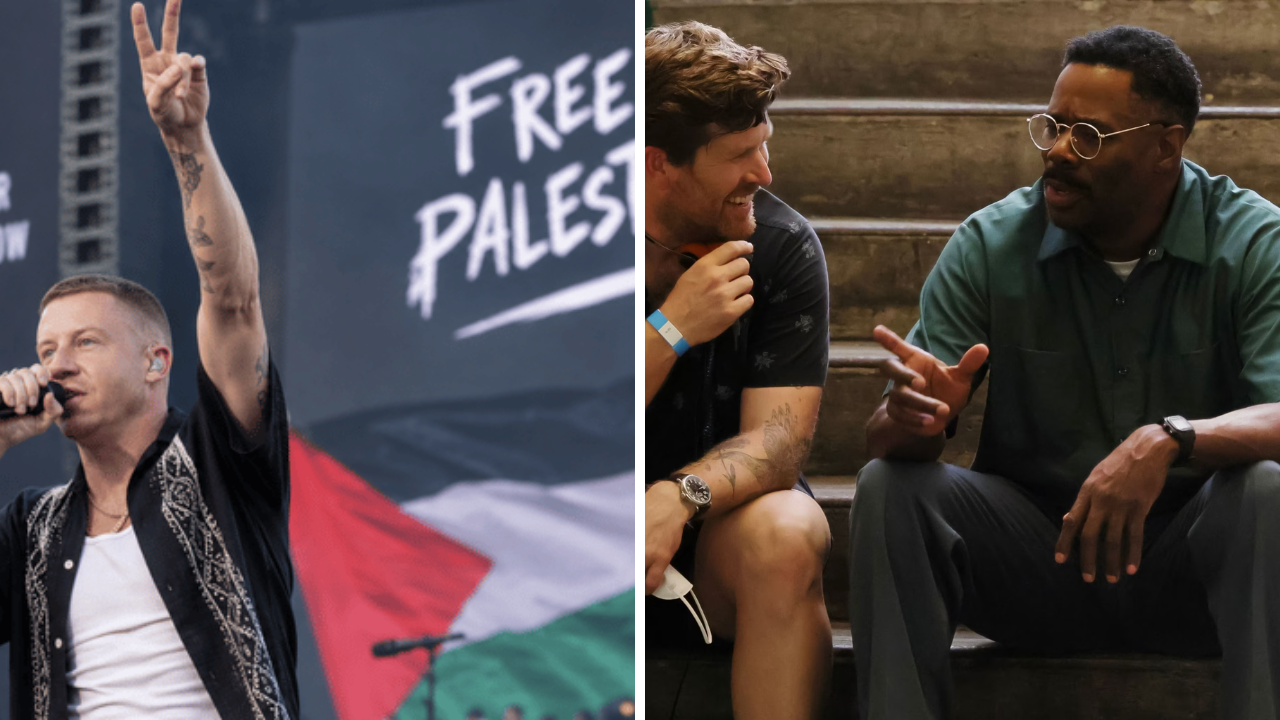
As I was returning from the 51st Toronto International Film Festival this week—my favorite film festival, and my third representing Black Girl Watching—Macklemore got kicked off of Ed Sheeran’s global tour for saying “Free Palestine.” Now, I do not listen to Macklemore or Ed Sheeran. I had no idea they were on tour. And now I am a subject-matter expert on the rousing speech Macklemore gave for Palestinian liberation during his opening act, and on Ed Sheeran’s sniveling cowardice, folding to pressure from zionist billionaire and Epstein Files member Robert Kraft to kick Macklemore off the tour.
As I arrived in Toronto for the festival last week, I had seen former blackfisher Pink crying about how the words “Free Palestine” made her feel unsafe (the darndest things make white women feel “unsafe” and it’s usually Black and brown people who have to suffer for it. I’m sure the slogans of the anti-slavery movement in America would’ve made her clutch her pearls too). And she got her wish to have Macklemore excommunicated from the stadium tour led by stadium owner Kraft and his Epstein Class cronies. But I don’t believe it was the phrase “Free Palestine,” that had them all shook. These two shows that Macklemore opened for Sheeran were played before an audience of 100,000 people per show. And they were all cheering, crying, chanting along with Macklemore that Palestine would be free. The zionist spell that has obscured their injustice of stealing Palestinian land, genociding the Palestinian people and ethnically cleansing Palestine for more than 70 years is lifting.
And now, thanks to the zionist fear, bullying and censorship of art, Ed Sheeran has lost his touring band and every other opening act who quit in solidarity with Palestine, and all credibility. A message that could’ve been contained to a few hundred thousand people over ten shows, has now exploded to millions of people and global news headlines for more than a week talking about the zionist genocide of Palestine and the waning power that zionists wield to silence free speech of the oppressed.
People have seen with their own eyes the IOF destroy Palestinian olive orchards, all Palestinian universities, books, ancient artifacts and architecture in an attempt to erase the evidence of thousands of years of Palestinian culture and life. People have seen Palestinian babies blown from their mothers’ wombs—I have seen these images over the past three years of live-streamed genocide, and I will never get them out of my mind. I will never un-hear the voice of Hind Rajab, the five year old girl whom the IOF slaughtered with 355 bullets. So when Macklemore memorialized Hind and the Columbia University protestors who overtook their genocide funding institution in protest of her murder with the song “Hind’s Hall,” and performed it with images from the genocide in Gaza to 200,000 people over two shows on tour, he reminded me of what Toni Morrison said: “Art is dangerous.”
It’s dangerous because it pierces through the consciousness of an audience and stays with them, impacting their emotions and their actions, consciously and unconsciously. Art is a weapon. How you wield it and who you wield it for matters. Macklemore chose to wield his weapon on behalf of the oppressed, genocided and ethnically cleansed Palestinian people. Ed Sheeran chose to wield his weapon against the oppressed, on behalf of a billionaire in the Epstein files. There is no such thing as apolitical art. All artists must choose, whether we like it or not. And the people will be the judge of it.
The Palestinian poet Refaat Alareer said in his final interview before being targeted and executed by the IOF: “I am an academic, probably the toughest thing I have at home is an Expo marker. But if the Israelis invade, if they charge at us, open door to door to massacre us, I’m going to use that marker, throw it at the Israeli soldiers, even if that is the last thing I will be able to do.” His art was dangerous to Empire and it cost him his life. Their fear of the power of our art is a matter of life and death, not mere comfort. That is the real sacrifice. Macklemore using his white male privilege in an art form he co-opted from Black people is literally the least he can do and it has cost him, but it will not cost him his life. For those of us within the belly of the beast, those of us who sit at the intersection of marginalizations—race, class, gender, ability, sexuality, geography—the cost will always be higher. Yet, that is the artists’ charge: to throw our markers, our films, our songs, our poems, our literature at Empire for the benefit of the people. For our own liberation.
Which brings me back to TIFF. In 2023, Colman Domingo’s film Sing, Sing premiered at the festival and was immediately my favorite of the year. Based on a true story, this film followed incarcerated men at the Sing Sing prison who participate in a performing arts program as a form of therapy in the high-stress conditions of the prison system. Formerly incarcerated men and graduates of the arts program starred as themselves alongside Domingo to tell a beautiful story of what art as a weapon can do, piercing through the cold concrete of our modern-day slavery institutions and giving hope and an outlet to men in chains to be free in their minds.
But what’s most remarkable about Domingo’s film is not just the story they told, but how they told it. Director Greg Kwedar and his producing and writing partner Clint Bentley joined Domingo on stage at this year’s TIFF for a panel on how they paid every single person who contributed to their film Sing, Sing equally—from the production assistant, to their A-list number one on the call sheet, Mr. Colman Domingo himself. Every person who contributed to Sing, Sing also got equity in the film, so when the film makes a profit, they make a profit too. On a usual film set, this would be extraordinary. On a film set with a majority cast of people who have worked for slave wages in prison, this is an extra radical act, a scream in the face of the dehumanizing prison industrial complex. It’s a damning act in an industry that thrives on the exploitation of workers, and the assumption that “stars” should get millions while the people who keep the sets running should just be happy to be there.
A film is never solely the product of the director or the star; it is the result of so many hardworking people who never get the credit for their work and can struggle financially while the films they work on make hundreds of millions around the world. The brainchild of Kwedar and Bentley, The Ethos Model of filmmaking is something they’ve now done successfully on two award-winning films, Jockey and Sing, Sing. And the filmmakers hope it is catching.
Watchers, I bawled my eyes out throughout this beautiful conversation moderated by Domingo, in a packed auditorium of cheering filmmakers. I felt more hope for the survival of human, ethical filmmaking than I ever have before. Their ethos of equal pay and equity in filmmaking is what I long to achieve. I long to meet producers, actors and other filmmakers who want to make this kind of dangerous art, for the people, by the people; for our collective liberation. I want to work with people who believe that it is possible for us all to succeed, and that there is a greater purpose, a dangerous purpose to the art that we make — and a tremendous responsibility.
Sing, Sing was snubbed in the Best Picture category of the Oscars, even though it was absolutely one of the best pictures of the year. I strongly believe the Hollywood Machine found Sing, Sing too dangerous to reward as a production due to the producers’ radical ideology of pay equity. What if other filmmakers and A-listers start banding together for equal pay?! Won’t someone think of the billionaires’ bottom line?! How can they control us if having more money than someone else is no longer a motivating factor?! Making dangerous art on behalf of the people will cost you something. But the reward and the new world the artists will build where we can all create and thrive is well worth the cost.
My Black Girl Watching podcast Another Possible World is my way of trying to connect with these kinds of like-minded filmmakers, to talk about the revolutionary ways we can use our art to free people and ourselves, without falling victim to the traps of this industry and the pressures of the Epstein class who seek our capitulation and control. I’ve been trying to get Black woman producer of Sing, Sing, Monique Walton on the podcast since its inception, so fingers crossed that that will happen. Until then, paid subscribers can enjoy this 45 minute video conversation from TIFF between Domingo, Bentley and Kwedar on how they equitably paid their workers to bring this film to life below the paid subscriber line.
Stay tuned for more dispatches from TIFF and stay watchin’!
Brooke
UPGRADE TO WATCH:


Leave a Reply