***SPOILERS FOR HOUSE OF THE DRAGON AND GAME OF THRONES***
Every time I think I’m out, they pull me back in! That incestuous white-haired family with the dragons is back on my TV and as I much as I would like to quit them—you know, because of the incest, and because I already know how the story ends from the books and from that little twerp Joffrey in Game of Thrones—I simply cannot quit them. I am a fire-breathing Leo and I deserve dragons. I love lore and ancient histories and misinterpreted prophecies. I love Black people in fantasy and a story finally centered around women.
House of the Dragon delivers on all fronts, but season three, episode two, “Queen’s Landing,” where Queen Rhaenyra takes her Iron Throne, offered the highest reward yet for my steadfastness. This episode is the best of House of the Dragon and ranks with the best of the Game of Thrones franchise, and now I’m locked back in.
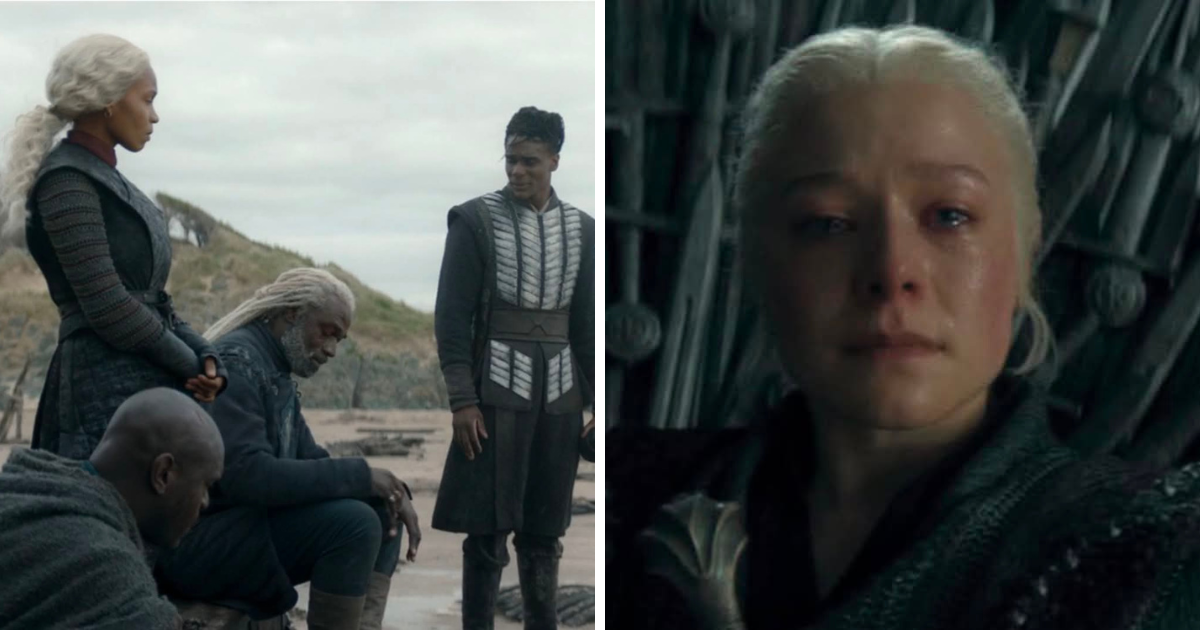
The revolutionary nature of House of the Dragon both for Black people and different races of women—and its inherently problematic nature—are made most clear in this episode. It’s not until “Queen’s Landing,” that we get a scene of only Black characters in a group. Lord Corlys Velaryon, The Master of Ships, and his two illegitimate sons, Addam, a dragonrider and Alyn, a warring seaman like his father, and Corlys’ granddaughter, the Lady Baela, a dragonrider who was next in line to be queen of Westeros. A team full of a hittas!

Yes, we’ve seen two Black characters speaking to each other alone before on this show: Alyn and Addam; Alyn and Baela; Baela’s mother Lady Laena and her sister Rhaena; Corlys and Alyn. But the Black audience lost our shit this week just seeing a group of the four of them alone together, without their white spouses/ betrothed/ counterparts. They’re regrouping after surviving last week’s sea “Battle of the Gullet,” with Lord Corlys at the helm, expertly driving the boat like an unc with a ‘78 Coup de Ville. Though they’ve won the battle, Baela has just lost her betrothed prince and her future as the queen, Corlys has lost his entire estate. But they have each other; they are officially all a family, with Corlys granting Addam and Alyn the gift of his high-born last name, Velaryon.
For a fantasy series, and for one in the GOT universe specifically, the presence and significance of these Black characters is revolutionary. I didn’t finish the books (but neither did the author! So, it’s fine!), but as a huge fan of the OG series (seasons 1-6 only), I can definitively say that the white male showrunners of GOT, David Benioff and D.B. Weiss, did not care about Black people or women. Enjoying GOT as a Black woman was like enjoying hip-hop: pay no attention to the rampant misogyny and anti-Blackness and just listen to the beat and clever turn of phrase. If you don’t get hype when the GOT theme music starts playing and the animation starts going, are you even alive? And who didn’t love the dragon queen Daenerys Targaryen who could birth dragons, be consumed in fire and remain unburnt, who was riding dragons bareback and setting all of her enemies aflame with one word: dracarys! Of course, they had to constantly remind their Black and female audience that we don’t really belong in their fantasies beyond props.
Daenerys, the only main character who kept Black and brown people around her, did so because she “freed” the Black and brown “slaves” who then dedicated their lives to her protection. In one of the nastiest scenes of Game of Thrones, the Black and brown people literally lift her lily-white ass up to crowd surf on them like the white savior she was.

The brilliant Jacob Anderson who is now killing it as Louis de Pointe du Lac in Interview with the Vampire/The Vampire Lestat was simply wasted playing one of those freed enslaved soldiers for Daenerys in what could’ve been an interesting role if the D&D showrunners cared anything about Black characters having depth or being anything other than enslaved people “freed” by white people and eternally grateful to the point of death.
It’s because of how Game of Thrones used (or didn’t use) Black characters that this week’s episode of House of the Dragon was so striking. Because Black fantasy lovers are starved for such images and scenes of us together, on the same side. Yet even from the premiere episode of the series in Summer 2022, Black people have existed not just as lords, ladies and dragon riders through Lord Corlys and his family, but also as a maester and adviser to the king in Kings Landing, and as regular folks doing this and that in the background. In fact, Black people are so prevalent in HOTD that I’m actually worried about what happened to them all between the time period of this show and Game of Thrones which takes place about 200 years later. I guess white folks are committed to doing 200 years of Black enslavement in every lifetime, including in their wildest fantasies. It’s true, skin color doesn’t divide the way having wealth and dragon-riding blood does in HOTD, but Black characters being a free and regular part of the biggest fantasy franchise, represented in all classes of nobility, while also having a moment on screen where we can just be Black together is rare and beautiful to see—regardless of how race might work in their world.
Just as rare on screen is the exploration of patriarchy through the lens of women of different races in fantasy. Even white women main characters in Game of Thrones were constantly punished on screen through the male gaze. Though Game of Thrones had some fascinating women characters—Cersei, Arya, and of course, Rhaenyra’s descendant Daenerys among them—it was largely a man’s game told from a male point of view, with women characters filtered through a man’s lens. From Dany to Cersei to Sansa Stark, the central white women characters on Game of Thrones and even random background women characters were all brutally and violently raped on screen throughout the long-running series, and gratuitously nude. It’s “realistic”; it’s “period accurate,” all the incel boys cried at any pushback from Black and women viewers for why Game of Thrones just had to treat all manner of women and Black people this way. Never mind the dragons and zombies and magic. It’s realism and period accuracy we’re going for here.
And then came House of the Dragon.
Three years after Game of Throne’s disastrous final season in 2019, the prequel series about the Targaryen civil war with dragons premiered. Even with male showrunner Ryan Condal on this series, House of the Dragon is decidedly female and therefore a fundamentally different show.
It’s still a man’s world, but in House of the Dragon, we see the patriarchy through the female gaze. When women are centered, we learn as an audience to focus and sympathize with women as the most important people in a story—something blatantly against what patriarchy conditions us to believe.
At its core are two women, Rhaenyra and her childhood best friend and lady-in-waiting Alicent. Both navigate patriarchy with wildly different ideas of what it takes to win the game. As a dragon-rider, the heir to the Targaryen dynasty and the future queen of Westeros, Rhaenyra was born into ultimate power. Her life’s motto is “who gon check me, boo?” The first woman pledged to sit the Iron Throne, Rhaenyra sees no difference between herself and her male ancestors, and exercises total agency over her body and her pleasure, as men are trained to do. She has no concept of not getting her way, as long as her father can drag his decrepit ass out of bed and remove her enemies for her. She is patriarchy’s princess, and her biggest weakness is not understanding that she can only be queen if the men around her allow it.
Alicent, by contrast, is the daughter of Otto Hightower, a high-born second son who ascends to power by scheming and pimping out his daughter to Rhaenyra’s widowed father, King Viserys. Alicent is socialized to believe that if she is a good girl for the patriarchy, she will be rewarded and happy. In a betrayal to Rhaenyra, she becomes queen to Viserys and serves men well: her father, her king husband, and then the sons that she bears for him. And she is miserable, sleeping with a decaying old man who calls her by Rhaenyra’s dead mother’s name. Alicent grows to resent Rhaenyra’s sexual freedom and agency over her own body and the way Rhaenyra flaunts her disregard for the respectable role women are supposed to play in society. Once Viserys dies, Alicent and her father plot and install Alicent’s son Aegon II on the throne instead.
Nonbinary actor Emma D’Arcy as Rhaenyra will go down in history for their performance in this week’s episode, and the quote “Bring Aegon—the YOU-ZUR-PAH—to me!” is one of those epic line readings that’s gonna ring in our head for weeks. What a stroke of genius and luck, having a non-binary actor playing the role of Rhaenyra who seeks to destroy the boundaries placed around her womanhood (if not all women), who simply wants to live freely—not as a man, but as men do. With D’Arcy as Rhaenyra, existing as non-binary, the audience is opened to a world beyond the gender binary and can view Rhaenyra’s story (and perhaps even our own) through the lens of gender-free possibility—and what’s lost when too many men, and Alicent as their humble servant, won’t allow it.
“You toil still in service to men. Your father, your husband, your son. You desire not to be free, but to make a window in the wall of your prison,” Princess Rhaenys (Rhaenyra’s cousin) reads Alicent for filth as she’s usurping Rhaenyra’s throne. Alicent plays her favorite game, playing ignorant to the truth and then acting shocked when her betrayals have deadly consequences.
Through Alicent, House of the Dragon shows the audience how utterly unfulfilling being a foot soldier of the patriarchy is for women. Through Rhaenyra, it reveals how unwilling we are for a (perceived) woman to be free, let alone to rule.
After this epic “Queen’s Landing” episode, where a grieving Rhaenyra takes her long and labored walk up to the throne, snot-crying as she goes, sitting awkwardly upon it, unsure if it was worth all that she has sacrificed, the audience called her “weak”.
Countless posts wished Rhaenyra would’ve been more of a “badass” in her ascent to the throne, like her descendant Daenerys. When taking what was rightfully hers, the audience said she should’ve been filled with rage and determination instead of crying with grief and walking slowly up to her new royal perch. It revealed the truth that this country has long-since proclaimed in real life: we do not actually want women to lead unless they perform strength like men do.
Because as much as this show is about women under patriarchy, it’s specifically about motherhood, and Rhaenyra is a grieving mother who behaves as a grieving mother does.
We’re with Rhaenyra as she births a stillborn daughter Visenya upon hearing that her king father has passed and Alicent’s son has usurped her throne. Just as her mother Aemma told Rhaenyra before dying in childbirth, the pregnancy bed is a woman’s battlefield. It’s violent, bloody, tortuous and lonely. Rhaenyra pulls her stillborn daughter out herself, as her now-husband-uncle Daemon and the men on her council ignore her screams of agony and plot the next course of action without her. But because Rhaenyra has been through this battlefield of pregnancy loss and has felt the consequences of it first-hand, she is measured in her response and slow to go to war. She knows what war costs.
Everyone around her doubts her leadership and her choice to try and avoid war as a womanly weakness without the stomach necessary to lead. Never mind that her father, a man, was a peace-time king and instilled in her the importance of peace in the realm above all. Never mind that she would be waging war against the other half of her family—people whom her beloved father also loved—not to mention the suffering of the rest of the kingdom. Every decision she makes is doubted because she is a woman. It’s only after Alicent’s second son Aemond kills Rhaenyra’s young son Lucerys that she knows peace is impossible and is therefore ready to go to war at the end of season one.
Season three opens with the epic Battle of the Gullet between Team Black (which literally includes the Black characters on the show) for Rhaenyra and Team Green, which is Alicent’s Hightower usurper branch of the Targaryen family. I wish I knew Rhaenyra’s eldest son and heir Jacerys better as a character so that his death alone would gut me like I know it’s supposed to. Like I know his little brother Lucerys’ death was supposed to gut me at the end of season one. My second-major complaint about the show is its rushed and awkward pacing, leaving us little time to know secondary characters like Luke and Jace. But I know Rhaenyra, and Emma D’Arcy acted their ass off as Rhaenyra seeing Jace dead for the first time. Rhaenyra yells at him as a mother would their rebellious teenager, as though he were alive and would answer her as commanded. That gutted me. Watching Rhaenyra move through denial to sheer agony, I was bawling along with her. D’Arcy is so powerful in this role that I started asking why my son had to disobey me and go get himself killed in a war. Watchers, I have no children.
But it’s with this context, wielding her dead son’s sword, grieving the loss of now three of her six children to this war, that she cries as she chops the head off of her biggest op, Alicent’s father and the mastermind of her usurpation, Otto Hightower. She walks heavy-footed through his pool of blood, leaving behind red footsteps as she ascends to her throne, mirroring her bloody walk through the Red Keep in season one after giving birth to her son Joffrey. The first shot we see of Rhaenyra on the throne is not head-on, but through her reflection in Otto’s pool of blood.

Her children are what it costs for the Queen to land.
“The boys who clung to me, who hid their little faces in my skirts, dead. So that I could sit upon the throne of swords,” she cries to Daemon earlier in the episode. Rhaenyra isn’t “weak,” she’s alive and feeling. She still handles business, yet doesn’t delight in the death and destruction. Men like Daemon would rush headlong into the “glory” of war without a second thought to what it would cost. A matriarchy, however, must consider the children.
Motherhood is central not only to Rhaenyra as a character but to the overall HOTD story. Rhaenyra is a kind and loving mother who raised sweet boys—a huge contrast to Alicent who, in her bitterness over being forced to marry her best friend’s dad and bear his children without pleasure, has raised entitled, bitter little demon sons who rape and pillage. But, like Alicent, Rhaenyra also set her sons up for failure.
Because Rhaenyra’s first husband, Lord Corlys’ son Laenor, a silver-haired Black man, was gay, and Rhaenyra wanted sex for pleasure, not just duty, they made an arrangement to keep up appearances but sleep with whom they wanted. As a result, Rhaenyra had her first three children with a guard from the City Watch, Ser Harwin Strong, which resulted in all of her sons being white with noticeably black hair. For the silver-haired, interracial couple, that was obviously a sign that Rhaenyra and her children’s legitimate claim to her father’s Iron Throne could be easily challenged, against her father’s wishes. At least cheat with a Black man, Rhaenyra, damn!!
“I could father a dozen bastards if I were a man and no one would blink an eye,” young Rhaenyra tells her father when he first approaches her about the possibility she had “lost her virture,” (to her uncle Daemon, no less!) before marriage —again, a conversation that would never exist if Rhaenyra were Raemond. Her father agrees with her and yet tells her that she’s a woman and this is a patriarchy and Rhaenyra doesn’t get a special “but I’m the Queen-to-Be” pass. Rhaenyra tries her luck at acting like a man anyhow.
Despite Alicent’s best efforts, including forcing Rhaenyra’s bloody walk through the Red Keep after giving birth, Rhaenyra refuses to be shamed for exercising agency over her own body. Alicent can only dream of such power over oneself and bitterly resents Rhaenyra for it (so much so that Alicent starts her own self-righteous affair with Rhaenyra’s old work, the incel edgelord Drake of Westeros, Ser Criston Cole). And Laenor’s father, Lord Corlys, always stood by Rhaenyra’s children as his own grandchildren, even though we can all see with our eyes that they are not Black! It’s hilarious and I love it.
It’s not simply out of the goodness of Corlys’ heart that he defends his legal grandchildren as his own blood. He also married off his daughter Laena to the king’s younger brother Daemon. The Master of Ships is an extremely ambitious man, and if his son’s legal children ascend the throne, or if Daemon usurps Rhaenyra as the male heir to his brother’s throne, either way Velaryons will be kings and queens of Westeros moving forward. “History remembers names, not blood,” he tells his white Targaryen wife Rhaenys, who is over the bullshit of Corlys’ ambition. It’s a fascinating racial dynamic that they’ve set up, making Corlys Black when he is not in the book. Because of Corlys’ ambition, tangling his children up with Targaryens, both Laenor and Laena die, causing even more friction between the houses when Rhaenyra marries Daemon immediately after Laenor and Laena’s deaths.
But in “Queen’s Landing,” we see exactly why no one but Daemon could be by Rhaenyra’s side in her moment of grief and triumph. Besides D’Arcy breaking out their best acting, what really made this episode so special was how much it catered to the female gaze. When I found out that this episode was written by Sarah Hess and directed by Clare Kilner, I understood immediately why it was so effective. Women behind the scenes can make a world of difference.
The episode begins with Rhaenyra, sick with a mother’s grief, unable to move from her bed. Only Daemon can reach her. He whispers to her in their ancient language, High Valyrian, reminds her of who she is and the greater cause they’re fighting for. He’s seen a vision of Daenerys Targaryen in the long-off future, and knows that Rhaenyra sitting the throne is the only way to make that world-saving future possible. (Let’s pretend we don’t know how Game of Thrones ends so it hurts less!) He encourages her not to let her sons die in vain. And she’s up, ready to go reclaim her throne. Her small council finds it a terrible plan to fly to King’s Landing with four dragons and no army but Daemon shuts them up with “she has me.” HOT.
Then, they do in fact fly to King’s Landing on dragonback, and Daemon proceeds to kill everybody in their path, and then looks back at Rhaenyra like Did you like that? and she gives him the same look we all have at home: YES! THAT WAS HOT!
“Who else dares rise up against us in our house?” He yells after slitting the last soldier’s throat. I hate violence, but my god. This clip of Daemon handling big business set to Usher’s “Daddy’s Home” has been playing on a loop in my house for several days. Thus raising the bar for men to actually be of service. Because if you’re not clearing a path to my throne with the blood of my enemies, why are you even bothering me? This is ROMANCE. This is DEVOTION. This is MALE COMPETENCY. Annnnd it’s also problematic as hell.

Rhaenyra and Daemon are very hot together; truly, they are twin flames. When they barge into the Red Keep, they do so in lock-step. When he clears a path for her to the throne, she takes his hand. When they’re surrounded on all sides inside the throne room, it’s his Que Dawg fraternity brothers in the gold capes that bend the knee to her, defeating the Kingsguard. And we love to see it. He is giving his all for his queen, the love of his life. But that is her uncle! She is his niece! We are salivating over incest! WE’RE UNDER SPELLS!! There’s literally no more appropriate song to play over Daemon hotly cutting down Rhaenyra’s enemies than “Daddy’s Home.” It works on every level because that man is literally a half-step away from being a father to her. CRAZY.

When Rhaenyra begs her uncle to marry her at the end of season one, we’ve already seen him groom her for this when she was a child, giving her wine, kissing and undressing her in a brothel. JAIL. ELECTRIC CHAIR. DRACARYS! But, no. By the time she’s begging her uncle to marry her, we cheer because they’ve been in love for years and their marriage literally saves Rhaenyra and her children from speculation over their legitimacy. We’re supposed to be relieved for these incestuous fan-favorites under these circumstances, which is a huge leap from the feelings we were meant to have during Game of Thrones.
In that series, Cersei and her twin-brother-lover Jaime were the literal villains of the show, and their incestuous bond was a trait of their depravity. This week some loser on Threads was lamenting about how he was ridiculed for shipping Cersei and Jaime back then but now everybody loves Husbuncle Daemon with his niece and it’s okay. All that tells me is that, after eight years of Game of Thrones, incest has become more mainstream and normalized. That’s bad!
Just last year, Durham University published an article about the rise and popularity of incest porn, growing from 1% of porn content in 2006 to one of the most popular categories on pornography websites by 2014, with no sign of slowing down.
“The prevalence of incest-themed content matters, as it normalizes and legitimizes ideas of sexual activity between family members – particularly involving young girls. When these messages are consumed by millions every day, the influence extends beyond individual users and filters into broader cultural attitudes,” Professor Clare McGlynn writes.
“In time, we may become desensitized, less likely to understand the prevalence of child sexual abuse, or its seriousness. The claim that incest porn is fantasy without real-world effects assumes incest is rare, abhorrent. But it’s not.”
Thanks to the rise in consumer DNA testing, we now know that 1 in 7,000 people are born to “first-degree relatives,” meaning a parent raped a child or sibling rape has likely occurred. Women rape boys and men; yet statistically, the largest group of rapists are men. Fathers. Uncles. Brothers. And that’s just what we know from the number of girls and women who produced children who lived. We can safely assume the prevalence of incest in our society to be much higher.
We know that images are powerful and help shape in our minds what is possible in the world. As we celebrate women-centered stories that reframe how we value women and Black characters revolutionizing what we think is possible for Black people, we must also consider what it means to normalize incest in fantasy.
And we are normalizing it. “The only incest I approve of!” read a post with thousands of likes on Threads. “Best Husbuncle ever!” was the caption of a trending video of Daemon at work. Social media was flooded with these “jokes” after “Queen’s Landing.” And as much as I loved this episode and what this show is doing overall for fantasy-loving Black Girl Watchers everywhere, I have to sit in this and my own discomforting response to it.
Because this episode also revealed something deeper about the show that is akin to Rhaenyra’s own dilemma within it: trying to be queen of a patriarchy. A show can be progressive and powerful, breaking ground for Black people and women of different races in fantasy. It can be full of queer characters and queer people in front of and behind the camera. But at the end of the day, we are adapting to and operating within a white man’s fantasy. This is George R.R. Martin’s wet dream. The source material of both their world and our current reality, is white male patriarchy. Of course incest would thrive. Of course rape of women and children thrives. Of course white supremacy and class hierarchy thrive. We have seen the Epstein Files. This is the status quo. And here we are, an Alicent, carving a window in our prison cell. Whatever joy, power and progress we claw out for ourselves within this system, inevitably, we will be made to bend the knee at the boundaries of the white male imagination. Our victory will be as short-lived as Rhaenyra on the throne, with death and destruction of the soul as the cost to ascend.
Of the entire Game of Thrones franchise, the one with the most power and the most sense was Daenerys’ dragon Drogon. After all it cost him, he let loose his fire on the Iron Throne, melting the swords into the worthless pool of metal it always was. Because real freedom won’t come in the form of Black people, queer people or any race of woman in the seat of power crafted for and by white men. It will only come when we burn it all down.
Stay watchin’,
Brooke


Leave a Reply