****Spoilers for the plot of Obsession and Get Out*****
Hollywood has crowned a new favorite white boy, Curry Barker, who impressively wrote, directed and edited a $750,000 horror film, Obsession and sold it out of TIFF for more than $15 million. Released by Focus Features in May, the film has gone on to make $250 million at the box office in just a few weeks.
Starring Michael Johnston (who looks like the boy from Hereditary) and Inde Navarette (who looks like Natalie Portman), Obsession looks a whole lot like white Get Out. Needless to say, it’s derivative. The similarities are beyond its low-budget genre fare and massive global box office return from a first-time filmmaker. Obsession takes “homage” to Jordan Peele’s horror masterpiece to the extreme, yet this poor man’s rip off fails to achieve the pinnacle of social commentary that Get Out achieved.
Using a man dating a perverted version of his “dream girl” as a premise, Barker has nothing substantive to say about dating and relationships, just a whole lot of editing actors walking in reverse to set a freaky tone. With Obsession, Barker has fulfilled the old adage that “imitation is the sincerest form of flattery that mediocrity can pay to greatness.”
The film begins with a cowardly “nice guy” named Bear (Johnston) who wishes his friend Nikki (Navarette) who has no romantic interest in him, would “love him more than anyone else in the world.” All of the horrible consequences of the film stem from that narcissistic, life-ruining wish. Instead of “love,” Nikki becomes obsessed with Bear to the point of murder.
But like Andre (Lakeith Stanfield) in Get Out, Nikki isn’t really Nikki; she has been possessed by an alternate personality controlling Nikki’s brain and body, while the real Nikki is in the corners of her own mind (a sunken place, if you will!), aware of everything that’s happening to her, but in control of nothing. Unlike Get Out, where there are rules for what triggers someone in the sunken place to escape the prison of their mind and re-take control of their bodies, in Obsession, Nikki pops out occasionally with no rhyme or reason to let Bear know that something is wrong.
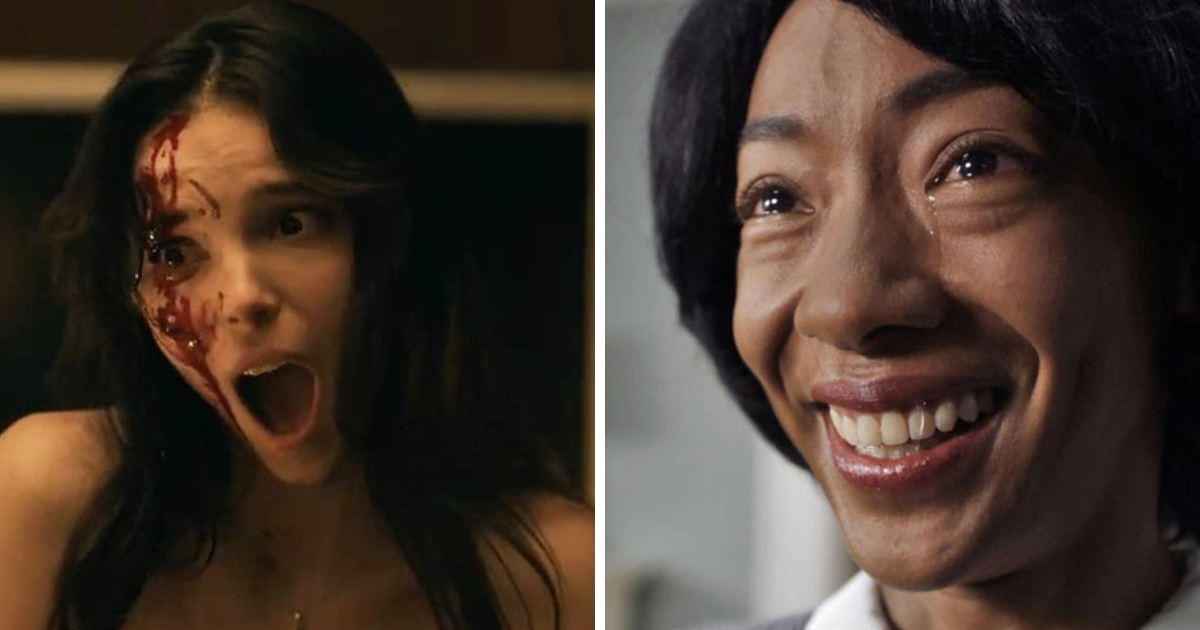
Just like the brilliant Betty Gabriel who plays Georgina in Get Out and made saying “no, no, no,” in quick succession iconic, Navarette’s Nikki copies Gabriel’s Georgina with a glassy-eyed smile and repetitive pattern while saying “no,” to let Bear know that Nikki isn’t being herself. (Watch for yourself below.)
A quintessential “nice guy,” Bear knows the real Nikki isn’t interested in him but wants to believe that he can treat her so well it shouldn’t matter. He knows something is off when she comes on to him and kisses him for the first time, but it’s only when the real Nikki pops out to say “what the fuck?!” that Bear expresses that she makes him “feel like a rapist” doing something wrong — which, of course, he is.
Like the white couple who bought Andre’s body off the auction block in Get Out, possessed him and has sex with his body, Bear is a rapist who has sex with Nikki knowing it’s not the real her. He dies for it all, but it’s unsatisfying, because the real Nikki is left with a pile of bodies in her wake while he, like the coward he is, gets to escape without being accountable for the crimes that have taken place and will ruin the rest of Nikki’s life.
So what was the point? What was the message? Why did I sit through this movie?
On second thought, to call Obsession derivative is far too mild and doesn’t quite capture what’s really going on at the root of this film’s success. Obsession isn’t smart. It isn’t layered. It isn’t nuanced. It isn’t commenting on centuries of oppression in an inventive way. It’s a straight forward “be careful what you wish for” film. There’s nothing inherently wrong with a straight-forward, crowd-pleasing film. This one, however, is ripping off one of the smartest, most layered, nuanced social commentary horror films of all time.
The brain transplant surgery Peele invents in Get Out satirizes white neo-colonization and enslavement of Black people. Mixing sci-fi with horror, Peele also comments on the long history of white scientists, surgeons and mental health professionals experimenting on and exploiting Black people to advance medicine and technology for their benefit at Black people’s expense. Peele’s film put 21st century racism on full display, taking direct shots at white women who prey on wealthy Black athletes and the Obama-liberal white people who still hold tight to their anti-Blackness with a few exceptions. This genius racial body horror story is so original, so thoughtful in its creation of lore, in establishing the rules of the world, in creating the technologies necessary for the satire of America’s racist history to work, that Barker’s laziness and lack of effort on all fronts in comparison with Obsession seem like a slap in the face.
The gag is, Obsession could’ve had something smart to say about patriarchy; about the ways that men are socialized to devalue women as autonomous people and how that can lead to pedestaling women without actually caring to see and know and love them as people. Bear didn’t “love” Nikki—he barely knew her. The “love” that he wished from her ended up being sick and twisted because it mirrored his own “love” for her: sick, twisted, self-serving, inconsiderate, narcissistic, fake, unconscious and deadly.
This idea connected to the larger system of patriarchy, of the ways that men systematically devalue women’s personhood for their own gain, could’ve been a worthwhile use of ripping off Get Out. Instead, Obsession is simply one boy’s silly wish gone awry, a story in a vacuum, outside of any social inference or analysis, with nothing to say beyond, “Oops! Did I do that?”
It reminds me, I’m rarely mad at bad films themselves—people make bad films all the time, they come and go and have zero impact on society. But the response to this film is yet another infuriating reminder that white filmmakers can afford to be cheap. They can be lazy in their storytelling. They can rip off Black brilliance, dilute it to its most simplistic form and outpace it in a matter of weeks. Whereas Get Out made $255 million at the global box office over a year’s time (it was in theaters around the world from February 2017-February 2018), Obsession has made a record-breaking $224 million in just over a month. Deadline also compares the films in its report on how Obsession’s faring overseas: “UK & Ireland grossed $2.6M this weekend to reach $13.8M cume, above Get Out at the same point.”
This poor-man’s rip-off has indeed made Barker very rich. He’s already secured an 8-figure offer for his next film before it’s even been pitched. But there’s simply no accounting for taste.
At the end of Get Out, Chris (Daniel Kaluuya) has survived the attacks of the white Armitage family that meant to enslave him, burning down most of the evidence and killing every one of his would-be enslavers. But Chris is a Black man in a wealthy white American world. Things look incredibly bleak for him at this point of the film, even after surviving such horrors. As he uses his remaining strength to choke the life out of his murderous girlfriend Rose (Allison Williams), flashing lights appear in the driveway of the Armitage home. The hearts of the audience immediately sink, especially the Black viewers: everyone knows the reality of Black people and police in this country, whether they’ll admit to it or not. But in a twist of love for Chris—for the Black audience—the police lights are really from Chris’s TSA agent friend Rod (Lil Rel Howery)’s car. It’s not the police coming for Chris, it’s his friend coming to rescue him. Chris has fought white supremacy and won. He is safe! And so, for about five minutes, were Black people as a whole.
I watched Get Out on opening weekend at the AMC Magic Johnson Theater in Harlem, surrounded by Black people (and some of the men’s white girlfriends) during Black History Month 2017. I have never had an audience experience like that in my life. I will never forget the uproarious cheers when Rod stepped out of that police car. It was damn near the first Juneteenth in that theater! It was catharsis. It was relief.
In the age of 12 Years a Slave, where torturing Black people on screen could win you Oscars; in the midst of the Black Lives Matter movement, where videos of police murdering Black people flooded our timelines, Chris got to be okay. In Peele’s reality, we would be safe. We would be saved. It was perhaps the first time that I remember watching a movie and thinking out loud oh, this filmmaker LOVES us!
There is no love in Obsession. Despite the rampant femicide in America, where women are often killed by their male partners, fathers, sons or complete strangers for failing to behave the way that men want, there is no catharsis for Nikki or women like her. Despite the likelihood that Bear would statistically be the one to kill Nikki and then go on a mass shooting spree, it’s Nikki who is possessed with murderous intent.
Unlike Chris, who has a good friend in Rod, who is concerned for Chris’ well-being and searching for answers on his behalf, Barker has created no girlfriends for Nikki—only competition. Sarah, who is supposed to be Nikki’s friend, has an obvious crush on Bear and she lures Bear outside, away from a sleeping Nikki to confess her crush to him, saying that Nikki is only using him to get back at their co-worker whom Nikki has been secretly dating for years. Sarah has no concern that Nikki has been acting wildly out of character. She doesn’t see Nikki as endangered or at the point of mental breakdown. She sees Nikki as a threat to dilute and winds up getting diluted herself.
Men are the center of Barker’s world, and the real tragedy of Obsession, Barker would have us believe, is that Bear can’t just like the woman who likes him back. A pitiful, weak warning for men that their “dream girl” could turn into a nightmare—for them. By the end, Bear’s suicide puts Nikki back into her right mind, only to be left literally covered in the blood of everyone she’s murdered, their bodies strewn about her. The ending is a scream. No words, just loud air with no point. Just like the film itself.
Stay watchin’,
Brooke


Leave a Reply