****Spoilers for BEEF seasons one and two****
TW: suicide ideation and domestic violence
For the past week since I finished my Beef season two screeners, I couldn’t quite put my finger on why it didn’t captivate me the way season one did. Then the head of directing in my writer-director program, Rob Spera, taught a class on Monday on what he calls the Fisher King Wound, and everything made sense.
The Fisher King, in Arthurian legend, was a king charged with guarding the Holy Grail. But he was wounded between the legs, rendering him impotent and unable to fulfill his destiny. Identifying your Fisher King Wound, as Professor Spera explained it (also in his book), is one way a filmmaker discovers their purpose. Why do we risk the instability, the rejection, the heartache that a career as a filmmaker can bring? It should be because we have something to say that the world needs to hear, and most likely, that need arises from an unhealed wound, a trauma that fundamentally rerouted our destiny and changed who we are and how we think about the world. Wrestling with this wound, healing this wound on film can be a profound gift to the world, an offering for an audience with a similar wound to know that they are not alone. My favorite films and TV shows are the ones where I can see the wrestling and the healing of the wound happening on screen.
Ryan Coogler’s Fisher King Wound, I would guess, is the trauma of slavery. His work often wrestles with what liberation is and how Black people specifically can obtain it. He struggles with this question most profoundly in his best and most awarded film to date, Sinners.
If I were to venture a guess about Beef creator Lee Sung Jin’s Fisher King Wound based solely on these two thematically similar seasons of his work, I would say that the questions he wrestles with are: Does unconditional love exist? Can you be fully seen and fully known and still be loved?
Lee’s answer in Beef season one is a resounding yes.
Season One
The Netflix series began as a limited series following Steven Yeun’s Danny and Ali Wong’s Amy as two strangers whose parking lot road rage escalates into a deadly beef for the ages. Incredibly narrow in focus, the world of Beef was anchored by Danny and Amy and the despair, loneliness and deep insecurity that led them to fixate on a perceived slight from a stranger in a parking lot. Compounded by their experiences as first generation Asian Americans in a white supremacist world (Danny is Korean, Amy is half-Vietnamese, half-Chinese), Danny and Amy grew up unwitnessed—even by their loved ones—ill-equipped to express the pain that it caused and unsafe with their families or even mental health professionals to unpack it.
“Western medicine doesn’t work on Eastern minds,” Danny says about why he refuses therapy, and turns to an evangelical Korean-American Christian church with doctrines also rooted in white supremacist ideology. His lack of accountability to fix his own life in therapy is meant to sound ridiculous. But after seeing even the wealthy and resourced Amy struggle with the same issues with an inadequate therapist, we see how insufficient a white supremacist mental health care system also is, as a tool to help these victims heal across the class divide.
When church and therapy don’t work, Amy and Danny do even more terrible things trying to be seen. They do wicked things trying to affirm their negative self-belief that they are too rotten to ever be truly loved. In the sickest twist of fate, their road rage beef allowed them to find in each other a kindred spirit in despair, matching each other’s freak in their increasingly unhinged attempts at revenge on the other. No one around them understood why they couldn’t just let it go. Even as fully grown millennial adults, they still didn’t have the language to express why this feud was not only important, but life-sustaining.
When we meet Danny in the pilot episode, he’s trying not to die by suicide, but the universe is literally telling him that he should (he thinks, incorrectly). He’s drowning in debt, he’s failed as a son and a big brother to Paul, he’s isolated, outcast and ready to end it all. He’s in the infamous parking lot of a retail store because the checkout attendant wouldn’t let him return the things he bought to assist in his suicide without a receipt.
Amy’s in the parking lot as well, and though she is, by all accounts, an extremely successful one-percenter and the breadwinner for her husband and young daughter, she is also deeply depressed. The white billionaire girlboss CEO of the retail store has been toying with buying Amy’s small business for years, with enough money that would change Amy’s life and allow her to retire and be with her daughter and stay-at-home husband. When she gets this money, she believes she’ll have the time and energy to work on healing herself. But the billionaire is still putting her through more hoops. And her Japanese husband George, whom she doesn’t yet know is cheating on her with her young, white employee, couldn’t possibly understand her struggles. He grew up wealthy and though his parents’ money is now gone, he’s transferred mommy duties to Amy to take care of him. Resentfully, she does. But because he is such a good dad, and she fears that her brokenness will infect her young daughter, she stays with George for the balance.
With all of this on her mind, she’s on edge, and feeling so small and powerless when a distracted Danny almost backs into her accidentally. She honks at him obnoxiously and with intent to shame him, blocking him in and flipping him off. Before either of them know it, their lives are changed forever.
Hoobastank’s “The Reason” plays at the end of the pilot as an almost gleeful Amy chases after a rapturous Danny who just got his lick back for her random parking lot attack the day before, and it’s clear: they can’t let the beef go because they finally found the only other person who understands why they can’t let it go. One-upping each other is the only way they can get a semblance of power and feel a sliver of joy and aliveness. They are the only people in their lives who can witness the other’s depravity and not shrink from it but meet it as a challenge to reveal how much more twisted they are inside than their loved ones could even fathom.
But Lee loves these two wretched humans, and even as he has them accidentally drive over a cliff chasing each other in a fit of desperation and unquenched rage, he offers them grace by soundtracking their cliff-diving with another millennial childhood banger: Bjork’s All Is Full of Love.
“You’ll be given love / You’ll be taken care of / You’ll be given love / You have to trust it
Maybe not from the sources / You have poured yours / Maybe not from the directions
You are staring at / Twist your head around / It’s all around you / All is full of love/ All around you.”
Watchers, I bawled my eyes out the first time I heard that song playing while these two absolute fools were at their absolute worst, driving over the edge in the dark of night. Their sight was obstructed, but all was full of love, and Lee knew exactly where he was driving them to.
The season one finale followed Danny and Amy lost in the California wilderness, injured from their car crash and completely vulnerable. They band together for survival, and over the course of two nights—and with the help of some poisonous hallucinogenic berries—they reach a defenseless state where they emotionally and psychologically meld into one person. There’s nothing sexual here, it’s pure soul-connection, soul-witnessing, soul-becoming. They have seen the absolute worst of each other and saw themselves in the other’s ugliness. In the end, they weren’t repelled but choose to snuggle closer together. Amy’s husband George couldn’t do that for her. Danny’s brother Paul couldn’t do that for him. Too much water was under those bridges. But they did it for each other.
In their final scene in the hospital, as both of these sick souls begin to mend, Amy wraps her arms around a comatose Danny, and in time, in a sign of life and hope, Danny reciprocates, reaching his arm around to hug her back. EUPHORIA!
I screamed at the TV, I cried, I rewound it to be sure I saw what I saw, yup! his arm moved! and then I screamed again. This is how you write a show. This is why you make a show! Healing people. Healing yourself. Showing people the love that they’re missing is not so far away. Hold on, and keep living.
Season Two
After winning several Emmys for the cast and crew, the limited series morphed into an anthology series, with its second season following a new stellar cast of characters unrelated to the season one cast. Moving from Los Angeles County up north to Oprah’s home of Montecito, season two is bigger in scope and scale, with twice as many main characters and a beef that stems from their roles at an elite country club.
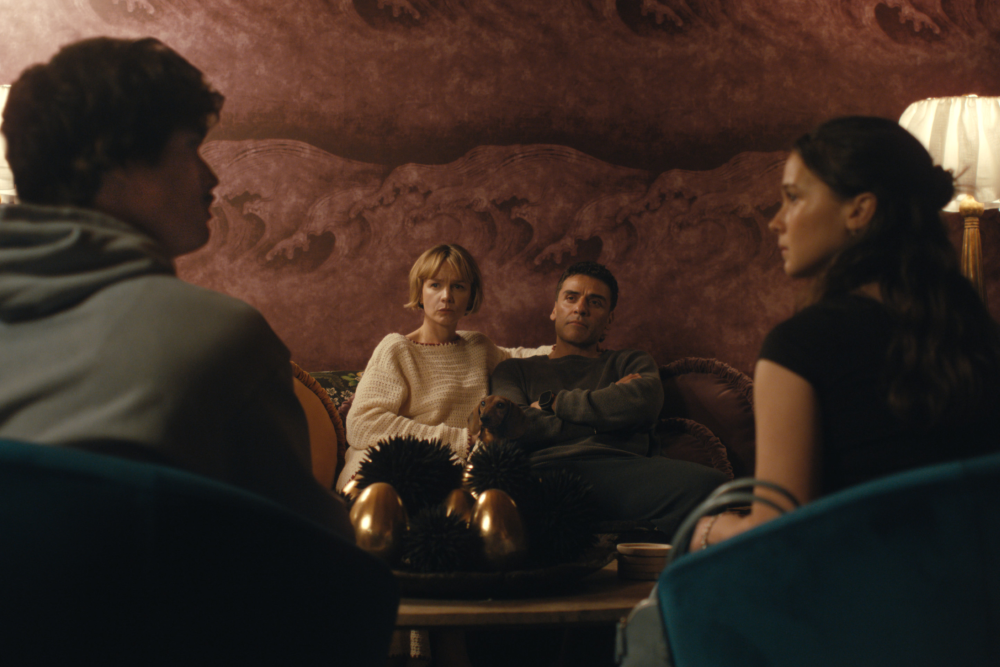
Oscar Isaac and Carey Mulligan star as Josh and Lindsay, a millennial couple on the verge of a meltdown. Cuban-American Josh (whose real name is probably Jésus) is the general manager of the club he’s worked at since he was a struggling teen. Despite his rise and his wife giving him her trust fund money, Josh is secretly in debt, trying to keep up with his one-percenter clients—to no avail. No longer independently wealthy, the white and British Lindsay is aimless and adrift, trapped in a sexless marriage that is her only defining quality. With no viable choice, she plays the role of dutiful wife, occasional interior designer and overall helpmate to Josh at the club. Beefing with Lindsay and Josh are Charles Melton and Cailee Spaeny’s Gen-Z waiters at the club, Austin and Ashley, a broke, interracial, newly engaged couple in the honeymoon phase of their young love. While returning Josh’s wallet, Austin and Ashley stumble upon a violent fight between Josh and Lindsay that Ashley records on her phone for safety.
But the couple has their first real fight over what to do with the footage. Austin wants to go to the police immediately. Ashley, as the only full-time worker at the club of the two of them, fears retribution. Soon, she also sees the footage as leverage to get a promotion with health insurance for a surgery she needs. Austin begins to look at his sweet fiancée with new eyes, and newer still when they go to Josh and Lindsay and use the leverage together, but only Ashley emerges with a full-time job and benefits. She negotiates nothing for him. He’s an afterthought. But the leverage is undeniable for the older couple who need Josh to keep his job. The beef begins.
Pressure mounts on the couples when the country club is purchased by a new owner, a Korean billionaire named Chairwoman Park, played by the legendary Youn Yuh-jun (the Oscar winner from Minari!) putting Josh on thin ice. And Austin develops a crush on the Chairwoman’s assistant, Eunice (Jang So-yeon), which, he confesses to Ashley, must be a byproduct of his awakened epigenetics (or cultural memory) as a half-Korean man, since he’s not been around so many Koreans since his childhood in Korea.
Both Austin and Josh have been adjusting themselves to fit a white wealthy world. Their white women partners help them to be received as passably white. When Eunice tells Austin over lunch that he needs more Koreans in his life, he shares he sometimes got confused for Mexican in school. Ashley interrupts his growing connection with Eunice by pulling him back to a neutral white “safe” zone: “I always thought of him as Arizonian,” she announces—clueless—and Austin reassures her in front of Eunice, saying how much he loves that their relationship is race-neutral (a.k.a whitewashed, bland, cultureless). In Josh’s world, a racist neighbor tells him to look out for a sketchy Latin man walking around the neighborhood. He tries to convince her that he is the Latin she’s been seeing and she rejects it outright: “No, you’re Greek.” It’s hilarious and telling. His closest client at the club, a white billionaire named Troy, often calls him “mi amigo,” and it’s a reminder: Josh isn’t so white, and his clients aren’t really his friends. Though the big bad billionaire villain of this season is no longer a white woman but a Korean woman and her crew of henchmen, it’s clear that white supremacist capitalism still has them all by the balls.
Josh has staked his value on serving wealthy white people, believing that one day, when he’s done enough in service to them, they may actually make him one of them. But Josh and Lindsay are just as much the help as Austin and Ashley are. The two beefing couples, both alike in indignity, are too wrapped up in their pettiness that they’re distracted from their common enemy—just as the capitalists designed it.
In one of the most horrific scenes of the show, Ashley suffers a medical emergency in a haunted house of an emergency room where untenable wait times and reckless, hostile medical staff collide, causing irreparable harm to Ashley’s body and future. Josh might’ve prevented the damage with a simple phone call he withholds because Ashley won’t delete the back-up video she has of his domestic violence with Lindsay. So, Ashley fixates on Josh’s role in her tragic loss, but Lee wants us to see the savagery of the American medical system in all its violent, flourescent light. To top it off, the health insurance that Ashley blackmailed Josh for, has a $5,000 deductible, which she learns in real time does not mean a deduction from the price. After her life-saving surgery, the kids are now $30,000 in debt and more desperate than ever.
A mirror image of the kids, Josh and Lindsay are so far in debt that Josh has begun embezzling from the club, with Lindsay’s approval. They can only get on the same page when it comes to sticking it to the kids or sticking it to the club. Still, each couple’s love for each other suffers under the weight of finances and identity that they don’t have, yet desperately covet.
“People love you,” Austin tries to reassure Josh about how well-regarded he is as general manager by the elite club members. But Josh, now having an incredible spiritual awakening thanks to a bofu trip, has seen the wretchedness of his true self, the deepest shadows of his character, and knows what his wife told him in episode one is true. He’s wasted his entire life aspiring to and serving people who will never see him as more than their servant.
“I grasp at all of that [love],” Josh tells Austin. “I steal it…to try to construct this crutch to prop me up because I don’t even know how to stand anymore.” He’s whitewashed himself and his morals and dignity so thoroughly to belong that he’s totally lost whatever grains of sand that once made up his uncorrupted self.
He warns Austin: “Whatever your Achilles heel is, that little spot—I know you think you’ve got time to work on it, and you do! But little by little, life’s just gonna chip away at it. And then, when you finally catch your breath and you go to stand on your own two feet, that Achilles heel is just gonna give out, and you’re gonna fall. And you’re gonna grasp at every one around you. But it’s too late.”
And now we see the Fisher King Wound. Josh knows he’s become a shit husband and a shit person, a thief, a liar and a fraud. Addicted to paying sex workers on OnlyFans, he hasn’t had sex with Lindsay in over a year. The worse he becomes, the more he’s confirmed that his wife doesn’t love him because he cannot be loved. And he doesn’t believe he’s capable of true love either.
His foil isn’t Austin, it’s Ashley, working her way up under Josh’s resentful mentorship. When Austin confesses that he’s not in love with Ashley anymore since her vindictiveness, lying, striving and manipulation has turned her into a self-absorbed mirror of Josh, Austin tells her the hard truth: she doesn’t love him either. She has abandonment issues from her parents who divorced when she was a baby and made separate lives without her. She simply doesn’t want to be left by him. She cries in such a way that it confirms the truth.
Austin is discovering in real time what Lindsay confesses to Ashley: Lindsay’s actions are motivated by a need to hide “the immense pain of knowing you picked the wrong person.”
Ashley counters Lindsay’s philosophy with one of her own: “You shouldn’t be looking for the right person but the right wrong person, whom you’ve seen you at your worse and you’ve seen them at theirs and you still want to stay.”
Amy makes a similar argument to George in season one, which he answers with a demand for a divorce. Lee’s fears about the fleeting nature of love resurface in Lindsay’s answer to Ashley:
“Maybe it’s just something people tell themselves because it’s too hard to admit that this thing which finally gave your existence some semblance of meaning is just a sham. Because then, what? You’re 40 years old without the faintest idea of who you are. And nobody wants that.”
The final couple Lee uses to wrestle with his wounds about love and its staying power is of the Boomer generation: Chairwoman Park and her plastic surgeon husband, Dr. Kim (the legend Song Kang-ho from Parasite). Back in Korea, Kim negligently kills a plastic surgery patient, and the Chairwoman seeks to cover up the crime by laundering money from the club. To cover up the cover-up, she sets a plan in motion to pin her money laundering on Josh, Lindsay, Ashley and Austin.
In the epic finale set in Seoul, the foursome finally understand what they’re up against and try to escape from Korea together. Kim, believing that the Chairwoman only loves him when life is good and not when his poor choices are interfering with her good life, decides to turn on her first and help the foursome.
“I feel like I’m being tested,” Kim says eloquently in Korean during an incredible arc shot in the hallway as the camera pans in 360 degrees from him to the wall, to the escaping Americans, to the other wall, and back to him. “We stay by each other’s side without ever receiving true love. And yet, we keep living with each other. Maybe that’s the test.” He believed at least Austin could understand what he’s saying. Unfortunately, Austin isn’t even close to fluent. No one speaks Kim’s love language. Just moments later, Chairwoman Park has Kim shot in the head to prevent his further betrayal.
“My second husband always said: ‘love is putting other person over yourself,’” Chairwoman Park tells Austin about Kim. “But as soon as you are born, you cry for mommy’s milk. You do not care about her. You only care about yourself. Maybe you put others over self a few times, but only when it is easy. The universe is not designed for this, thank God. We survived billions of years—from tiny cell to bacteria to monkey—because we only care about self. That is why capitalism works. It is a system of nature. A system of the self. Love lives in this system. All relationships exist in this system. They’re all the same. Another way to serve the self.”
And there it is, the biggest Fisher King Wound of the season: True love—like ethical consumption—can’t possibly exist under capitalism. It’s by far Lee’s most depressing conclusion.
Josh tries to prove this wrong, sacrificing himself for the love of Lindsay and even the kids, by taking full blame for all the crimes the Chairwoman planned to pin on the four of them. In a lifetime of selfishness, his grand gesture of love is finally selfless and self-sacrificial. Lindsay feels it deeply and appreciates it, promising to wait for him and support him through his long sentence.
She ghosts him a few years into his sentence, remarries and finally has the child she always wanted. She tosses around the word “love” to her new family like she said to Josh the last time we see them together and one wonders what she means by it. She hides from her new family in the bathroom while watching Josh on the news. He’s spent his years in prison doing exactly what he did at the club: being of service to others, in hopes it will benefit him and bring him love. He does seem incredibly changed, however, when his fellow incarcerated brother tells him that Lindsay moved on around the time she stopped communicating with him. Though his grand gesture was a little too late and the choice to stick by him was a little too hard, he’s content in knowing that she’s alive and happy. He doesn’t bother her again. He proves the Chairwoman wrong—true love does exist—but he remains punished, unrequited and alone.
Austin breaks up with Ashley for Eunice and, thanks to Ashley’s act of love—or manipulation, or a mix of both—he and Eunice have the information they need to go to the police and try to bring down Chairwoman Park for her crimes. But that’s not what happens.
Perhaps it was Eunice’s half-hearted reply when Austin says he loves her; perhaps it was Chairwoman Park’s monologue that capitalism is natural and love only exists within that self-absorbed system—whichever blow cut through, Austin decides not to take the incriminating evidence to the police with Eunice. Austin, the most eager to do the right thing and involve the police in episode one, has learned over the season a bit more about how the powerful work and how useless the police are to stop them. Instead, he’s pragmatic and does what Ashley wanted him to do in the first place: turn the evidence over to Chairwoman Park, bowing to her literally and metaphorically, to secure his and Ashley’s safety and future at the club and sealing his own fate. What he judged Ashley for doing at the beginning of the season with Josh and Lindsay, he’s done now as well—and with much higher stakes—with Chairwoman Park. Austin may not have understood what Kim was saying in his beautiful Korean monologue, but Austin ends up living out Kim’s hypothesis: that we stay by each other’s side without ever receiving true love as a moral test.
The season ends where it begins, in Montecito, 8 years later. Ashley’s fully into her evolution as Josh, serving the rich as general manager of the club, Austin by her side like Lindsay, playing the dutiful, deeply resentful spouse, visibly seething in “the immense pain of knowing you picked the wrong person.”
Chairwoman Park splays herself out over her husband’s grave, “an old woman filled with regret.” Even money, she laments, cannot stop time or change the cycle of life. But, even though she has a sads over murdering her husband, she still won. Josh has taken the fall for her money laundering, her dead husband’s crime no longer needs to be covered up, and she remains a powerful billionaire. Lord knows what happened to Eunice, but I doubt she survived if the Chairwoman would off her own husband (and even her first husband’s hot son!) to hold onto power. What’s an assistant? Austin probably dodged a literal bullet with his about-face evolution into a practical man who knows that billionaire capitalists always win.
I should’ve known that this is how it would end.
Whereas season one’s symbolic animal through-line was the crow—a harbinger of spiritual messages, transformation and growth—season two’s creature motif was a trail of ants, hive-minded and marching in line as designed. The finale episode is even titled, “It Will Stay This Way and You Will Obey.” “Love Like a Sunset” by Phoenix plays over the credits. “Right where it starts, it ends,” they sing.
Still, it stings. Lee seems to have reversed his season one position on the hope and possibility of true love, or at least saw fit to argue the other side: True love is impossible under capitalism. The system is too big to fight. There is no hope for any of us but to suffer and survive.
Lee underscores this message as his thesis of the season with the final image of the Buddhist wheel of life. With Chairwoman Park in the center of the wheel on the grave of her husband, the other couples and events from the series surround her in the circles of the wheel, representing the saṃsāra, or the cycle of existence in Buddhism. The karma for the choices they make plays out within the wheel’s four layers and six realms of reincarnation. Yama, the god of death, is the creature seen holding the wheel, representing the impermanence of the cycle of life. But what Lee excludes from this final image is the most telling of all.

In typical images of the wheel of life, Buddha rises above the wheel of suffering on the right side and points to the moon positioned over the wheel on the left side. The moon represents Nirvana, and Buddha’s pointing to it represents hope for reaching it, hope for liberation from the suffering of life and hope for an end to reincarnation.
But Lee’s wheel has no Buddha and has no moon. He refuses to be a guide and point his trapped audience towards a hopeful exit from suffering.
Believe me, I get it.
This is, no doubt, the most realistic possible ending. As the Zionist lobby AIPAC brags about how many of our politicians it owns and makes loyal to a foreign state, and our senile anti-Christ president threatens to “wipe out the entire nation” of Iran to cover up the Epstein files allegations that he and his billionaire pedophile buddies rape, kill and eat children, who wouldn’t believe like Lee that we are simply stuck in this billionaires’ cycle of hell. April 15th has come and gone, taking our tax dollars to fund the US-Israeli genocide of Palestine and Lebanon and the war on Iran, as well the RSF’s genocide of Sudan. Our tech overlords have ensured the continued genocide in Congo so they can keep profiting off of the country’s cobalt while Congolese children die working in mines.
The billionaires have destroyed every journalistic outlet we’ve ever had and filled our feeds with A.I. slop so that they can both censor real news and keep us confused about what’s real and what’s fake. They’ve stolen our lands for data centers to run the A.I. they’re forcing down our throats, poisoning our air and water while offloading the costs of electricity onto us. They’ve hoarded all the wealth and forced us to fight each other for crumbs, to see which of us will win the Hunger Games for a chance to be the General Manager at their zoo, keeping all the poor underlinings in line and in service to the Epstein class, like good, dutiful ants.
In light of this, I reconsidered the ending of season one and the pure euphoria of hope I felt for Danny and Amy, to be witnessed and to love and to live. But perhaps there is hope in the ending because the finale cuts off too soon. Hell—or the consequences of their heinous actions—will surely be awaiting them when they get out of the hospital. In fact, Danny’s arm is still moving towards Amy when the episode cuts to black, basically screaming “premature ending” at an audience that’s willing to hear it. Maybe it was always a cynical tease.
Hopeless energy does match the earth’s vibe in the 2020s.
In the same week that CNN broke the news about an “online rape academy” where men teach each other how to drug and rape their wives and girlfriends and get away with it—a site with more than 80 million views last month!—several Black women were murdered in their homes by their husbands, partners or sons. Yesterday, it was announced that the Black former Lt. governor of my home state murdered his Black wife who was divorcing him. She’d successfully won custody of their children and he was ordered to vacate their home by the end of the month. Her name was Dr. Cerina Fairfax, she was a dentist and a mother, and a beloved community leader. And she was almost free of her abuser. Then the coward murdered her in their home while their children were upstairs and killed himself to avoid accountability for her murder, leaving their teenaged children to discover their bodies.
Once the news broke, hapless negro rape, abuse and murder apologists spent yesterday posting their smiley photos with the murderer, eulogizing their Alpha phi Alpha fraternity brother, their neighborhood hero. Their “good” man and friend that they’ll miss. They lamented not the loss of Cerina’s bright light or that he snatched her from her life and her children. They barely said her name. Their cries were instead for their promising political rising star who flamed out when “unfair” yet credible rape allegations by two Black women kept him from his entitled spot as the most powerful political figure in the state. (He believed, because his accusers were Black women, it would actually help his gubernatorial campaign, à la Clarence Thomas and Anita Hill, as Feminista Jones pointed out. Misogynoir, he believed, would work in his favor. For once, it did not.) They lamented not the rape of two women, but the rapist’s “mental health” and what the allegations “stole” from him. I cussed them. I cursed them. I hexed them. And the reality of the pure hatred and disregard for Black women’s lives and mental health continued unabated.
As a Black woman, I know on a visceral level that Lee’s conclusion is true: There is no possibility of true love under white supremacist, capitalist patriarchy. Friendship love might be less dicey, if everyone is of the same class and not competing with each other for resources. But women who date men are in the unique position of looking for love with their number one predators. Love under pain of death feels like a cruel joke played on us, if we’re willing to roll the dice where one of the possible outcomes is our murder. Wrap it up. Start the Wrapture, Jesus. It’s simply too hard to love under all that hate.
This is my Fisher King wound that I try to heal in my work, writing the things that are not as though they are. It’s why season two’s ending felt so deeply unsatisfying and dare I say triggering. Fine: the foursome couldn’t actually take down the whole system of capitalism. But wouldn’t it have been wonderful for just one billionaire to get their comeuppance for once in a fictional show? Couldn’t Beef have continued to be the show that proves that love does conquer all—even a beast like capitalism—or at least can put a hell of a dent in it? It’s so disappointing that Lee’s answer here is “no.”
There are some genuine laughs in every single episode of Beef season two. Charles Melton is the perfect himbo and Carey Mulligan, Oscar Isaac, and Cailee Spaeny are deliciously wicked. With a shorter season and more characters, Lee still manages to put on quite a searing spectacle that entertains and informs.
But that hopeless ending gets stuck in the throat.
Stay watchin’,
Brooke


Leave a Reply