***SPOILERS FOR THE PLOT OF ‘IS GOD IS’***
“You so mad, Twin.”
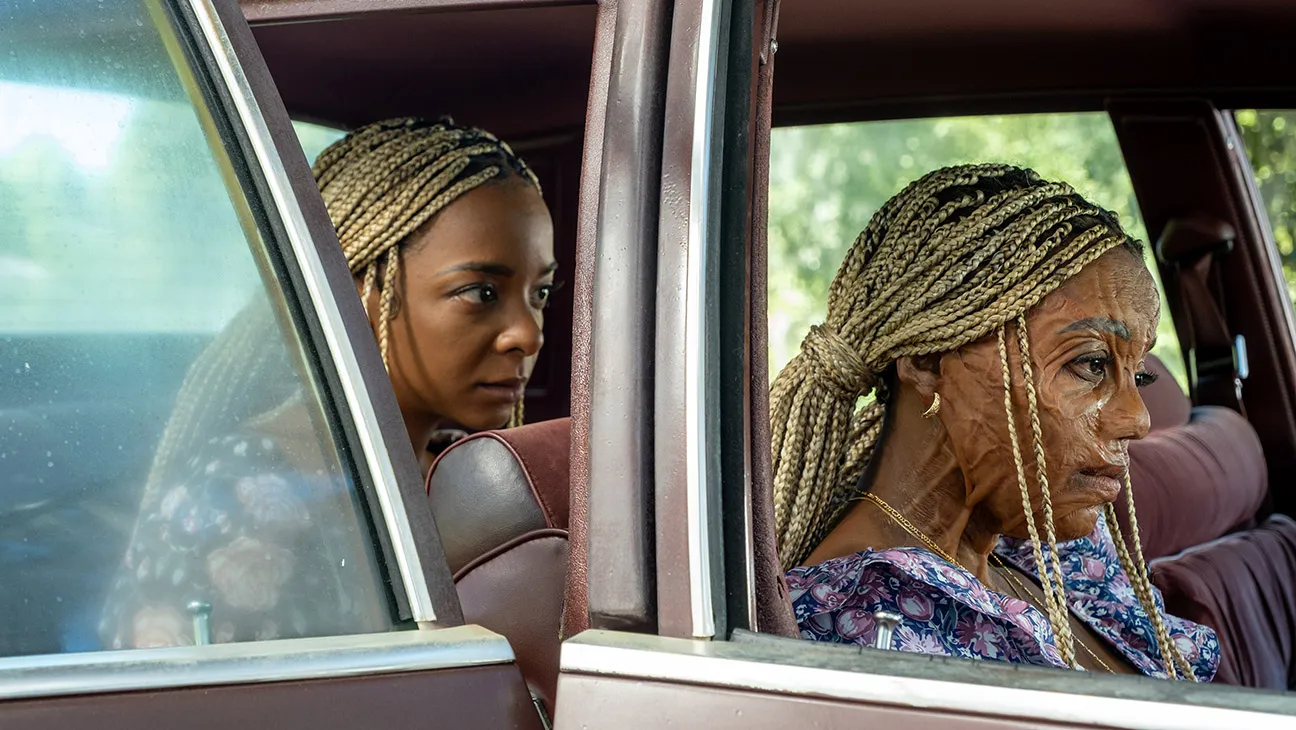
Anaia (Mallori Johnson) says this to her older twin sister Racine (Kara Young) in the new revenge thriller Is God Is. There’s judgment in Anaia’s voice, sadness—fear even.
“Aint you?” Racine retorts with tears in her eyes and Anaia doesn’t answer. Anaia might be angry about their father, the Monster (Sterling K. Brown) for abusing their mother Ruby/God (Vivica A. Fox) to the point of restraining order. She might be angry about him breaking into their home, choking their mother out and setting her on fire in front of them when they were three years old. She might be angry that the flames from the fire disfigured her face forever; that no one can even look her in the eye without horror and discomfort. She might be angry that, day and night, the twins take turns rubbing ice on each other’s still-burning scars (Anaia’s are the most visible on her face, while only Racine’s left arm is fully burned, her fingers melting into something claw-like). But Anaia is still not as angry as Racine.
Racine, it seems, is too angry.
Paid subscribers can watch my interview with writer-director Aleshea Harris below.
It’s the main source of conflict between the twins throughout playwright Aleshea Harris’s fiery directorial debut—what’s the acceptable amount of angry to be over what’s been done to you? To Black women? Adapted by Harris from her Obie (no relation) Award-winning play of the same name, Is God Is follows “burning twins” Racine and Anaia who have been charged by their mother Ruby whom they call God to “make [their] daddy dead. Real dead.”
“We ain’t killers,” Anaia says. “Ain’t we been killed?” Racine answers.
Growing up in foster homes, the twins were subjected to physical and sexual abuse and denied the truth about their parentage or how they got their disfiguring scars. What’s the appropriate amount of rage a Black girl should have for all of that?
Now, God has written Racine (not Anaia) a letter telling her that she’s not dead like their many foster parents had told them—but she is dying. And she needs her girls to come and see her before she goes. Not to give them the love they’ve been craving, but to send them on this deadly mission of patricide and revenge.
It’s such a contrast within the most striking scene in the film, of God in bed, clothed in brown and green like a tree, surrounded by her Greek chorus of nurses who wear red and pink like blooms, who braid God’s hair and speak in unison. Even Racine and Anaia wear matching flower dresses as they sit on God’s bed like the fruit of her branches. In death and dying, the Black Mother of all is revered, not just by her children, but her nurse attendants, anointing her head with elaborate braids. Unlike in the courtroom—where the Monster was acquitted of the horrors he inflicted on his family—in God’s room she is believed. She is supported. She is cared for. And she is defended.
When the Greek chorus removes the blankets covering the lower half of God’s burnt body and steam rises up from God’s skin, Anaia is horrified. Racine is angry enough for war. “Just tell us where to find him.”
The title, Is God Is, Harris told me in our interview (paid subscribers can watch it below), is simultaneously a statement of fact for Racine and a question for Anaia. She is God ‘cause “she made us, didn’t she?” But would God abandon us for decades and send for us only on her death bed to give us a deadly mission that would damn our souls?
With this tension at the center, I thought this story was Harris’ way of deconstructing Christianity, examining with a harsh light the ways the religion has kept Black people and Black women in particular from the full range of our humanity and emotions. There’s no turning the other cheek in the face of abhorrent violence against us.
By nature of the spaghetti western/Blaxploitation/Southern gothic/mythic adventure film, we spend very little time with the source of their scars, the Monster, seeing him only from the mouth down or his menacing feet in Sperry Top-siders. Brown plays the Monster with a disarming mildness, a soft-spoken gentleness that explains how easy it’s been for him to circumvent justice. A Monster could be beautiful, unassuming, and double-cheeked-up on a Tuesday. He decides when you get to see his real face.
In a redux of the reaction to 1985’s The Color Purple, some Black men are already up in arms about the “negative portrayal of Black men” in Brown’s character. Funny. Exactly a year ago, Black men flooded the theaters celebrating a different set of Black daddy-killing twins in Sinners. I wonder what the difference could be. Nevertheless, Is God Is’s story of a Black patriarch who attempts to murder his Black wife and children, exists in the context where this happens regularly in real life.
Just last month, a Black man murdered eight children (7 of his own) and tried to kill his wife as well as a former partner who mothered 3 of his children. Literally yesterday, a rapper murdered the mother of his children and shot himself on livestream to escape justice. Black men killing their Black wives and children is a crisis that has persisted for decades, and Is God Is merely shines a light on the aftermath, and the culture that created this crisis in the first place. If only that reality were as enraging to these men as the portrayal. If only justice were something within reach for these Black women and babies. So, we turn to film.
How will they feel once they kill their father, Anaia asks. “Better,” Racine answers. “This is purpose. This is destiny type shit.” It seemed that Black women’s righteous anger for the harms we’ve suffered was holy evidence that we have selves worthy of defense. And when we render justice, we won’t be “all sad-sacky,” as Racine calls Anaia. We will feel better.
But this interpretation is immediately undermined by the imagery. Anaia doesn’t buy into the truth of feeling better after revenge, and Racine, the shorter twin, is positioned on screen behind Anaia, talking over her shoulder like a perched devil trying to convince Anaia to do something bad and wrong.

Still, it’s easy to think that this film might have a message of deconstructing Christianity and its role in oppressing Black women because immediately after Racine convinces Anaia to come along for the ride to find their Monster father, the first person the twins meet on their journey is a Southern cult preacher by the name of Divine the Healer. Played with the perfect combination of absurdity and sincerity by Erika Alexander, Divine the Healer is the woman the Monster took up with during his trial for attempted family annihilation.
She either believed in the Monster’s innocence, or, like the real-life defenders of wife-murderer Lt. Gov. Justin Fairfax (and let’s face it: the defenders of most famous Black men who harm women) she simply didn’t care about what he was accused of. Presumably, this “woman of God,” saw the scars on the Monster’s wife and children and dismissed them, excused them. She “healed” the Monster with her bosom, like Iyanla VanZant squeezing Jonathan Majors to her chest and Meagan Good marrying him after his domestic violence conviction.
Her god was the Monster. Divine shirked her own divinity as a mother when she bore the Monster a son, Ezekiel (Josiah Cross), and raised him to deify the Monster—a father he’d never met before, because the Monster abandoned them the second he was acquitted of his crimes, changing his name and fleeing town to start a new life without all of them.
Still, Divine built an altar to the Monster from his left-behind items: a can of Barbasol shaving cream, a razor, a shirt, a tie. He left this pregnant woman behind like so many toiletries. Yet Divine stomps around her pulpit in boots as silver as the coins Judas earned when he betrayed Christ, just as she betrayed God and her children to side with their oppressor. She even built the Monster a church, and grew him a cult congregation that speaks and moves in unison, that wears all white like the bride of Christ, waiting diligently for his return.
But he’s not coming. Racine tells Divine how pathetic her decades of waiting and willing submission to the Monster are when she realizes the role Divine played in supporting their Monster in the immediate aftermath of his crimes against them. This earns Racine Divine’s wrath. “You are septic with rage!” Divine chastises her for simply telling Divine the truth. The truth-tellers are often dismissed as demonic and angry. Even Anaia chastises Racine for her inability to stay quiet in the face of Divine’s foolishness, fearing an inability to get the information that they need. Racine proves Anaia wrong: you can tell the truth, shame the devil and still accomplish your mission.
I thought this was all evidence of Is God Is being a treatise on patriarchal women and the ways they uphold men and the violent system of patriarchy to the detriment of themselves and other women and children.
Janelle Monáe’s character Angie was, I thought, the culmination of this message. Just as guilty as Divine, if not more so, Angie married the Monster after he was acquitted and changed his name. She had two twin boys with him, Scotch and Soda Riley, and she was aware that he had had other children with his first wife. Her only concern, however, was with whether they would have to pay child support. He told her that the girls were dead with their mother. Angie thought she was different, the exception to his monstrous violence. Until she wasn’t.
“She should’ve left!” Angie screams about God when confronted by the twins for her part in their misery. Angie was in the process of leaving the Monster—and her two boys—behind. She’d been planning this for some time after more than a decade of his abuse. She was smarter than God was and therefore “deserved” to get free, unlike God, who deserved her fate, she says. Up until that point, maybe Angie was yelling at herself for staying with the Monster far longer than God ever did. Women who suffer abuse can internalize that shame and lash out at other women and girls who remind them of their own shame. But then Angie curses God. Says the Monster’s violence was God’s fault for being “ghetto trash.” That kind of victim-blaming of women and white-washing of violent men has to die. So Racine made sure Angie did.
And then that ending changed what I thought I knew about this movie’s message.
Until I interviewed Harris, I didn’t know that Is God Is was meant to be a Greek tragedy —epic in scope yet tragic in its ending. Perhaps I would’ve been better prepared than thinking it would be a rah-rah revenge film à la Kill Bill where the Bride gets to kill Bill and live happily ever after, but for Black women, for once.
That’s not what happens.
After Racine kills Scotch and Anaia kills Riley, they have their showdown with the Monster. They tag-team beat him into submission just the way God told them: “destroy the spirit first, then the body, like he did me.” The Monster staggers away from his girls into a poetic dead-end: the bathtub. Just as he had doused God in alcohol and lit her on fire in the tub, they do the same to him. The literal definition of revenge. But it doesn’t satisfy. Racine, the closest to him physically—and, the movie argues, spiritually—gets pulled into the tub by the Monster and burns alive as Anaia escapes.
The foreshadowing of Racine’s elimination and the justification for it had already begun much earlier. Divine had cursed her. The attorney Chuck Hall (Mykelti Williamson) who defended the Monster in court and got his tongue ripped out by the Monster as gratitude deems Racine just like her father “in the eyes.” Angie called her an animal. But it was Anaia’s disgust with Racine that revealed her fate from the beginning.
“You gon’ get struck down,” Anaia says to Racine when Racine calls their mother God for the first time. In a patriarchy, where women and children exist primarily for the benefit of men, that kinda thinking will get you killed.
“What if he grabs one of us on the way down?” Anaia asks and predicts Racine’s demise as Racine brainstorms ways to kill the Monster, including pushing him off of a building.
“You’re enjoying this too much!” Anaia yells at Racine before Racine had even killed anyone yet. Can’t a girl hype herself up to “Guillotine” by Death Grips with the windows down and a blunt in hand while on a retributive road trip without judgment?! Damn.
Anaia’s reaction to Racine’s killing of the “bougie bitch” Angie let us know how the film feels about it too. Racine’s anger is out of control. Scotch (Xavier Mills), who humiliates Anaia in front of all of his friends by calling her ugly, doesn’t deserve for Racine to kill him in Anaia’s eyes. “But I am though!” Anaia says, revealing how she feels about herself and moreso how she’s treated in the world.
In our patriarchal society where beauty is currency, being ugly means being unworthy of love, care, humanity. Because Racine was “pretty,” she could be mean and fight back against their oppressors; she had a right to. Anaia, as she said in the beginning of the film, was “too ugly to be mean,” so Racine had “both of their mean.” Even the framing of Racine as “mean,” when really she didn’t bother anyone who didn’t bother them first, already created the image of Racine as unreasonable, unruly. Racine kills Scotch for calling Anaia ugly because he was complicit in the world in which ugly meant a loss of humanity. Not only was he complicit and a direct beneficiary of that world with his wealth and handsomeness and closeness to their father, he had the nerve to delight in the inequality at Anaia’s expense.
When “ugly” means “unworthy,” and Anaia shouts back “But I am though!” All of her behavior throughout the film makes sense.
Ol’ Dude, the unknown man Anaia has unprotected sex with, only allows her to have sex with him if her back is turned and he doesn’t have to look at her face. This is the father of the baby she’s secretly pregnant with. When Racine asks Anaia to think of what her life would be like if the Monster hadn’t burned them up, Anaia fantasizes about facing Ol’ Dude, sitting in his lap in the backseat of a car (presumably where they have sex) and him telling her how pretty she is. (GIRL. Aim higher!)
It is no wonder, then, that when the opportunity arises, Anaia chooses her half-brother Riley (Justen Ross), with whom she’s had only a five-minute conversation, over Racine who has protected her their whole lives and warned her that Riley was dangerous. Of course, it takes Riley 10 seconds to try and murder Anaia, and Racine has to swoop in and save her and almost gets killed herself in the process.
By the time it’s time to kill their Monster, all it takes is some tender-talking for the desperate Anaia to believe the Monster’s lie that it was God who grabbed ahold of Anaia while she was burning and that’s why Anaia is so badly burned. It took literally nothing but a soft man’s voice whispering literal sweet nothings for her to doubt her mother. We know his story that Anaia’s burns are her mother’s fault isn’t true because, 1) he literally lit the fire. Everything that came after that was his fault. And 2) Though the scene is a black-and-white close-up of the Monster’s face—the main tool Harris uses to let the audience know that we’re watching a flashback—there is no actual scene of God grabbing Anaia or the Monster trying to stop her. Because it didn’t happen.
When God tells her story, on the contrary, we are there in the scene with God. We know the Monster is lying in his sick justification for setting God on fire (“she wouldn’t let me hold her”) because we see God let him touch her and hear her explain why she let her guard down for a deadly split second (“men like your Daddy always got a tender side).” And then we see him choke her unconscious immediately. One would think that a man capable of the evident depravity engraved in Anaia’s own face could easily tell a soft-spoken lie.
But not Anaia. She’s immediately skeptical of her mother’s story, if not completely trusting of the man called Monster. “Just her,” the Monster tells Anaia of his evil intentions with the fire he set close enough to burn his children regardless of his excuses. “Not you.” Well then! Let me put down my weapon and have a seat with dear old dad! Let me desperately grasp at his promise to bounce my unborn baby on his knee—in a grandfatherly way, not the I tried to murder my whole family and you’re next kind of way!
I’m so glad Racine was unconscious during her sister’s dumbassery and didn’t have to witness it. Between this, Anaia’s immediate trust of Riley and the fact that she’s pregnant by a man who only has sex with her from the back so he doesn’t have to look at her scarred face—it’s easy to conclude that Anaia is as male-centered a pick-me as Divine and Angie. Of course, it took the Monster seconds to go from caressing to slapping the spit out of Anaia’s face on the side that is the most scarred from burns. He says her unborn baby is the only thing stopping him from cutting her eyes out and making her eat them. I don’t know that I believe him. If he could kill his living child, what’s an unborn baby?
This betrayal of her trust is what inspires Anaia to stay on her mission to kill him. Unlike Racine, Anaia’s kills of Riley and the Monster count as self-defense because she was in imminent danger of death. Racine’s “self-defense” has passed the statute of limitations and is simply cold-blooded murder. Even as their flesh still burns from the crimes against them daily. Even as steam still rises off the flesh of God more than twenty years later, the time for retribution in many people’s minds is still never.
Instead of a deconstruction, Is God Is couldn’t be more Christian in its assessment that seeking justice against and consequences for the people who harmed you makes you “just as bad” as them. “We come from a man who tried to kill our mama and a mama who wants to kill that man,” Racine says to reject Anaia’s claim that they aren’t killers. “It’s in the blood.”
That blood, Harris argues, has to die.
In our interview, Harris describes Racine’s death as “poetic,” having been birthed in a way, by fire and dying in the same way. I would argue a far more “poetic” end for Racine would’ve been to survive both fires, twin bookends for a new life that she could have, that was a bit more joyful, a bit more free. What could her path towards healing with these evils behind her have meant for her character? What could it have meant for all the Angry Black Girls in the world who are constantly told that the problem isn’t the injustice waged against them but their reactions toward it?
In my 2019 review of Queen & Slim, which I called “an artful wound with no medicine,” I coined the Hurston-Walker Test. Quoting from Alice Walker’s brilliant introduction to Zora Neale Hurston’s book Barracoon, the Hurston-Walker Test is how I engage with Black art that depicts our difficult history and reality: “Those who love us never leave us alone with our grief. At the moment they show us our wound, they reveal they have the medicine.”
We know well the wounds that makes us angry. But there is no medicine in this ending for the Angry Black Girl. There’s no healing. There’s only a continued message that even the ones closest to you—the ones you’ve spent your life fighting for—will see you and your anger as the problem, and will be happier without you.
In the end, Anaia stands alone, herself reborn a God, holding her newborn creation: another daughter. Is God Is, indeed. But what kind of God is she going to be? Her sense of shock at Racine’s demise seems to melt into what I can only describe as relief. Racine, it seems, was the one holding her back all this time, and now she and her baby can go be happy and live in peace without Racine’s angry energy.
The Angry Black Girl gets sacrificed in favor of the softer, quieter, patriarchal woman who can benefit and borrow from the Angry Black Girl’s fire when it suits them—just long enough to survive til the end—then blame the Angry Black Girl for stirring up the fire that saved them in the first place.
“I think there’s something kind of complete about cutting off that energy [of the Monster in the killing of Racine] because Anaia doesn’t carry that energy,” Harris told me in our interview below. “And for the story, I don’t think that Anaia could go off and rock that baby and live a semblance of a normal life with Racine at her side. I really think Racine would have continued to escalate.”
But this is a fictional film, and Racine neither had to die nor escalate her violence in the unwritten future. With all respect to the God of these characters, that idea of Racine is also not supported by the text of the film.
As Racine and Anaia set the Monster on fire and watch him burn, Racine’s first thought isn’t glee and rejoicing or even blood thirst, it’s conviction over what she’s said to her sister when they were fighting over Riley earlier. Racine apologizes to her sister for saying mean things to her, and holds her hand. At no point was she ever a physical threat to her sister, putting down her rock-in-a-sock murder weapon to prove as much. When Anaia turns her back on Racine to save Riley, Racine never touches her. She’s too hurt by her sister’s judgment. The only thing worse than anger is being alone in the anger you thought was shared. She’s devastated when Anaia runs away with Riley, not violent. She lets them go until Anaia’s life is in danger and then she saves Anaia and her unborn baby from Riley.
Yes, Racine is angry. And she’s also full of love and devotion.
The most devastating moment of the film comes at its midpoint, when the twins begin their walk to the Monster’s home. While trudging through open fields, they find a water fountain oasis. They laugh and gulp the water from the fountain, Racine the most drenched and quenched. “Twin, do you feel like this is too good to be true?” It turns out, it was just a dream. There is no water oasis for these burning twins; only Anaia alone.
What a cruel thing to tease that the angry Black girl’s fire might get to be quenched with justice that rolls down like a waterfall and righteousness that flows like a mighty stream, only to snatch it away in the final moments of the film. What a choice to make her destiny be one of eternal burning, too angry for the world and therefore too malignant to exist. It simply did not have to be that way.
At least in Harris’ original play, Anaia does not feel relief at Racine’s death. She goes back to God to tell her about the Monster and Racine and God is indifferent to Racine’s demise. It upsets Anaia. This was at least some evidence that Racine deserved to live and that her death was unjust, and that, most of all, Anaia did not think she was better off in the world without her sister.
In my reading of the play, Anaia hears God’s indifference and does what Racine would do: brings that rock-in-a-sock down on God’s head. This was the deconstruction of religion that I thought was happening, that uncaring Gods who “don’t want nothing but blood” are not our makers, or at least don’t have to be. We could choose our loving selves.
But Harris told me in our interview that my interpretation of the play’s ending was incorrect. Anaia doesn’t actually kill her mother in the play and she rewrote the ending in later versions to clear up that common confusion. Anaia simply puts down the sock and walks away from the violence for good, showing that the Monster’s energy would not continue with her or (fingers crossed) her baby. While both endings are disappointing in light of this new information, I still much prefer the play’s ending and Anaia’s confrontation with God over Racine’s death rather than this damn-near gleeful Sound of Music ending where the wicked witch is dead and Anaia is free.
Racine, the one who worshipped at the feet of the Matriarchy; who was pretty enough to abandon her sister for the burden of a man’s affections, but smart enough not to trust “pretty” or men, and aimed for a higher calling; who defended her mother and sister to the death—this was the one fit to be sacrificed in order for happiness and peace to be restored. It’s cruel.
Aleshea Harris has written a compelling world and characters that I loved and rooted for and has given fantastic debut direction to this film. Kara Young is a star, Mallori Johnson is one to watch, Erika and Vivica make everything better. Sterling K. Brown is exactly who he thinks he is. Alexander Dynan’s cinematography is incredible. The music from Moses Sumney is haunting.
But damn. That ending.
Is God Is could’ve been iconic, offering Black women the fullness of their righteous rage, satisfaction in their revenge and a salve for their burning scars. Instead, it offers final judgment, giving fire and brimstone to the Angry Black Girl who is simply too angry and unhealable to let live.
Stay watchin’
Brooke
Enjoyed this piece? Tip your writer!
WATCH: Writer-Director Aleshea Harris on all the details of ‘Is God Is,’ why she chose that major death and how her film differs from her play (and read the play below!):


Leave a Reply