**** SPOILER ALERT FOR THE PLOT OF THE DRAMA****
I often put spoilers in my reviews because the lawyer in me likes to make my case and back it up with evidence. But sometimes, like in the case of my review of Queen & Slim, I spoil to warn people in advance. So, in case the “plot twist” of Robert Pattinson’s The Drama hasn’t already been spoiled for you, trigger warning (literally! yikes!) this is a romantic comedy about potentially marrying someone who planned a school shooting in her youth.
You might be asking: who would think marrying a failed school shooter is a great premise for a rom-com? The answer is: Kristoffer Borgli, the Norwegian writer and director of this film. Borgli was born in the same year as I was, according to Wikipedia, so, I wonder: was his childhood also shattered by the Columbine shooting in 1999? Did he learn how to run in a zigzag from the school to the parking lot? Did he do school shooter drills as a kid? Nearly 30 years later, do his nieces and nephews have bullet-proof backpacks instead of gun control? What does he know about school shootings besides what he consumes of American media? Nothing. He is a Norwegian white man from Norway making light of American tragedy.
In this navel-gazing thought experiment of a movie, Borgli wonders: What if you were an original white man from Europe marrying a [generic] American woman and you find out the week before the wedding that she had planned a school shooting as kid and didn’t go through with it—not because she felt bad, she just never did it—would you still marry her? And wouldn’t the drama of it all be a laugh?!
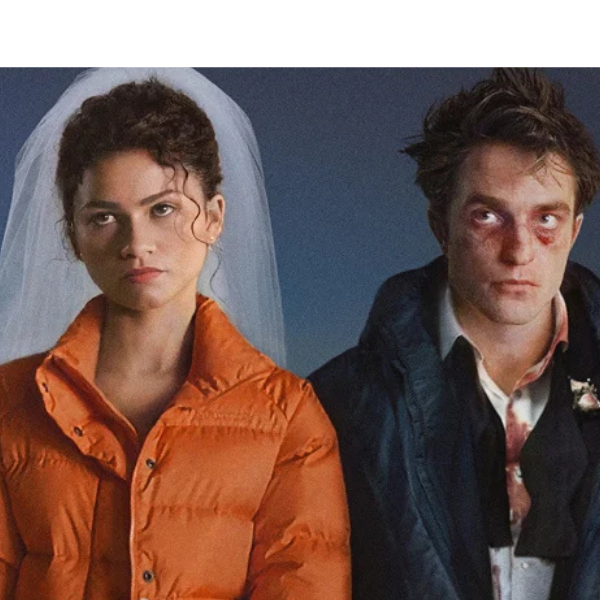
This confession of Emma (Zendaya) to her British fiancé Charlie (Pattinson) sends him spiraling in comedic ways. Who is this stranger he’s marrying? How could he love someone who could think to do something so heinous?
Make no mistake: this is Charlie’s story. Despite the marketing and the red carpet fashion pushing Zendaya to the forefront, Emma is not an equal character in this white male fantasy. She is an empty shell for Pattinson’s Charlie to rage against, stretching the depths of his own humanity, love and compassion. He’s the only one in this story with an arc, whose emotions are fully realized, who gets to be a human. As is typical for her at this point in her film career, Zendaya is a blank canvas for a white man’s projections and emotional growth.
In Challengers, Zendaya’s character was the human embodiment of the tennis net and ball that both separated and bounced between two white men who each had much more interesting things to do and characters to be, on their own and together. In the Dune franchise, as well, her character exists to show the emotional progress of Timothée Chalamet’s main character. Zendaya recently mentioned her desire to work with Ryan Coogler, but why not find the Nia DaCosta to her Tessa Thompson, someone who can center a Black biracial woman’s story and render her a full character on the screen for once?
Zendaya’s character is not the only woman who suffers from thin writing in The Drama. Alana Haim’s awful maid of honor character Rachel revels in her own moral superiority over Emma, but a better actress would’ve played this one-note villainous Karen with more depth, and a better writer than Borgli would’ve written this character with more than one note.
But Borgli isn’t interested in anyone else but Charlie, a foreign-born, self-insert character. And while casting the A-list Zendaya as Emma might’ve seemed like a boon for the film’s marketing, it simply brings Borgli’s painfully limited range and lack of foresight into full focus.
It was already absurd that Borgli wrote a white woman character who planned a school shooting in her youth. Make no mistake, despite the casting of Zendaya, Emma was written as a white woman and Zendaya plays Emma as generically as possible. Though a few white women and girls have committed mass shootings before, everyone knows the vast majority of school shooters—and mass shooters in general—are white boys and white men. This is a white problem and a male problem. Exploring the white male Charlie as the potential mass shooter and the terrifying depths of white male rage while having Emma run around town melting down at the thought of marrying a sleeper-cell psycopath, apparently, would’ve been less funny to Borgli. The twist is that it’s a girl! I can almost hear him patting himself on the back.
How funny that a seemingly kind, sweet, innocent, beautiful white woman with a cute hearing impairment—Charlie found Emma being deaf in one ear endearing!—could plan something so heinous as mass murder of children. And like real-life white woman shooter Audrey Hale, Emma had no real motive for the plan that she could share with Charlie to help him understand why. Some popular girls called Emma stinky and pushed her into a puddle on the sidewalk, making her drop her iPod or Zune or whatever music player it was. Emma shares that she had been wrapped up in incel chatrooms where being a girl who was into school shootings made her stand out and feel special and accepted—by a bunch of white incels. Why this was attractive to her as a Black biracial girl? We’ll never know, cause she’s not a developed character. Emma just “liked the aesthetic” of being a girl with a gun, and that was enough for her to plan a school shooting and record a manifesto until her computer randomly dies right in the middle of it. After someone else commits a mass murder that same day, Emma decides not to go through with it.
To put it bluntly: this is some white people shit. Just, all the way around, this is white nonsense.
Not only does Zendaya have a paper-thin character to work with, her casting also pushes this premise beyond the brink of believability, underscoring the racism of the other characters, while absolutely no one addresses it in the film. No one calls Rachel a Karen, though there is a clear racist undertone and aesthetic to Rachel delighting in publicly humiliating a Black woman. No one calls out the racism of Emma’s white husband-to-be for being terrified of his secretly Angry Black Woman. “Race-blind” casting isn’t a thing when everyone is written as white and we’re all watching white people gang up on a Black woman as if there are no racial power dynamics at play. Whether he noticed or even cared, it’s obvious that a Norwegian white man was not up to the task of tackling the impact of the racial imagery he was creating in the production of this film.
The biggest elephant in the room, of course, makes the entire premise of the film fall apart: Black girls don’t do school shootings. It’s not a thing. Anywhere!
But what would make a Black girl plan a school shooting and then never follow through because this is some white boy shit? would have been a fascinating undertaking. And if Borgli wasn’t interested in that undertaking, or doing the work in the script to make Emma a biracial Black woman beyond casting a Black man as her father for 90 seconds of screen time, then Borgli should’ve just cast someone white.
Inclusivity in filmmaking is beyond casting; it’s about creating characters with depth who are rooted in reality. The little sketch of a character that we have as Emma is actually interesting and ripe for a more curious writer-director’s exploration. As is often the case in a Zendaya project, her character Emma is the only Black girl in a white world. Sure, there are some Black boys sprinkled in, including the teen boy in Emma’s high school who takes a liking to Emma and ironically nominates her to lead their school anti-gun violence campaign. And then there’s the wasted talent of Mamoudou Athie, who plays Charlie’s best man Mike, but is equally racially unspecific, other than in a throw away line where his wife Rachel shares her false belief that her Black husband must’ve grown up “around guns.” Because the audience can see he is Black, she doesn’t have to say it, and we know to gasp or laugh at such a wild thing to say. But Emma doesn’t react to Rachel’s claims about Mike’s upbringing at all, though certainly it’s more evidence that, with her white mom, white girl frenemies, and white fiancé, she is the only Black girl in the space, from childhood to womanhood. Would that not inspire some rage?
With all of the injustice and the institutional colliding of racism and sexism and the adultification that Black girls face, Black girls would be hella justified to have rage. According to a 2024 study from the U.S. Government Accountability Office, Black girls “receive more frequent and more severe discipline in school than other girls.” This is a systemic, institutional failure of protection—from teachers to principals to school administrators. This is not to mention the disproportionate rates of domestic violence and sexual abuse Black girls face at home and in their communities. The most unprotected people on the planet would have a right to rage. But we simply don’t process our anger in mass shootings. We are much more statistically likely to be victims of violence rather than perpetrators of it. Yet the stereotypes of Black women and girls—as unrighteously angry, as violent, as hypermasculine, as “strong” enough not to need or deserve protection—persist.
With a few tweaks, this film could’ve highlighted both the systemic failures that lead to the erasure of Black girls’ humanity at the crucial age of development, and the root cause of mass shootings: Congress and the gun lobby, and our healthcare and (mis)education systems. This film could’ve shown that mass shootings don’t happen in a vacuum and are not solely an individual choice of individual bad actors but are the rotten fruit of a society built on and sustained by violence. That’s a film whose comedy would punch up at power, punch up at systems, and challenge the people who have actively chosen to uphold them or to passively look the other way.
Real-life family members of victims and survivors of school shootings have expressed similar concerns about the lack of intention in this film beyond laughs and hypotheticals and have spoken out against it. Tom Mauser, whose son Daniel was killed in Columbine in 1999 told TMZ in March that he thought the film “normalizes” school shootings. He also took issue with the flippant way Zendaya laughed off the “twist” in a Jimmy Kimmel Live! interview.
March for Our Lives, an organization created by child survivors of school shootings, spoke out against The Drama and its film studio A24 for its failure to alert the public that this rom-com contains extremely sensitive subject matter that the audience wouldn’t suspect. “The way this film has been marketed is deeply misaligned with the reality it engages,” they posted on Instagram. “We expect better from A24 and the artists behind it.”

Jackie Corin, a Parkland school shooting survivor and co-founder of March for Our Lives, told the Hollywood Reporter that “Gun violence, particularly in schools, is not just another dramatic device. Art has the capacity to deepen public understanding and create emotional clarity and awareness, but it can also flatten and distort reality, especially when it leans on shorthand or tries to make something more palatable than it actually is. With something like a near school shooting, even small tonal choices can shift whether a story feels productive or dismissive.”
But, Borgli has no interest in understanding why school shootings happen. He doesn’t care about American survivors of mass shootings or the relatives of the victims. It’s as if they’re preemptively being mocked for being upset with the film’s comic tone through the character of Rachel, whose cousin was paralyzed in a mass shooting and therefore reacts to Emma’s confession in such an outlandish and cruel way that it’s played for laughs. He’s certainly not interested in Black girlhood or womanhood for that matter. Emma isn’t rendered as a real person (Black or white) because she’s not based in any reality; she’s a premise. This film isn’t personal; this is comedy for him. He just wants to laugh at our pain.
Borgli isn’t trying to be “productive.” The Drama is the movie version of a social media troll trying to provoke and ending the post with “Thoughts?”
And we’ve seen what’s in Borgli’s “thoughts” before. He’s also the filmmaker behind the Nicolas Cage-starring film Dream Scenario, where a white man is castigated for thought crimes that he didn’t even think. A film that warns of the dangers and harms of “cancel culture” for white men is quite the preface to a newly resurfaced essay Borgli wrote in 2012 where he bragged about the “May-December relationship” he had at 27 years old with a teenaged high school girl while her parents were out of town. Knowing that the “relationship” was, at minimum, “socially unacceptable,” he went looking in movies for evidence that he wasn’t some old weirdo creep. He literally researched “May-December romances on film” on Wikipedia and found hope in Woody Allen’s movie about an old weirdo creep grooming a high school student in the infamous 1979 film Manhattan.
“If a film made in 1979, in which Woody Allen’s 42-year-old character has a public relationship with a 17-year-old girl, is portrayed exclusively in a positive way and causes no controversy in its own time, then why shouldn’t my relationship – with a considerably smaller age difference – in 2012 be “within bounds”? I chose to listen to Woody over my friends,” Borgli wrote, sans irony or shame.
Citing Woody Allen—who married his girlfriend’s daughter in 1997 and was credibly accused of child molestation by another daughter in 1992—as a guide for ethical dating habits in 2012 is a choice. It’s that unthinkable white man shit again.
So, why wouldn’t the guy who wonders “what would Woody Allen do?” when dating, cast Zendaya in her twenties to play a love interest to Robert Pattinson who’s pushing 40? Gross age gaps are par for the course in a pedophilic Hollywood, and so are school shootings in America. Perhaps Borgli figured Americans wouldn’t mind, and hey, it’s not like Americans have stormed the Capitol and White Man’s House over murdered elementary school children in Uvalde or Sandy Hook, or over the allegations in the Epstein files of cannibalism and raped children by the people who run this country and the President of the United States. For all of Borgli’s misguidedness in this film, perhaps he assumed correctly about American audiences on those two counts.
The ending of this film is meant to be sweet, a testament to the power of true love to overcome any obstacle—even if it puts you through the ringer first. The final image of Charlie’s smiling yet battered face drives that point home. But in truth, Borgli made a horror film where a biracial Black woman is now trapped in a marriage with a white man who harassed a woman in a wheelchair in the middle of the sidewalk; who cyberbullied a kid until the kid had to move schools; who fetishized his Black wife’s disability until he learned the ugly truth about it; who cheated on her at the first opportunity; who began their relationship on the lie that he shared her interests; and, when she needed it most, showed none of the grace and empathy for her that she’d shown him throughout their relationship. They can’t start fresh when she asks for forgiveness; only when Charlie cheats and is also in need of forgiveness is he ready to wipe the slate clean—people make mistakes, after all!
But like all of Borgli’s films and his gross essay, his latest thought experiment is unintentionally revealing. In The Drama, we see the emotional violence of white women, the terror of self-pitying, petulant white men, real-life tragedy reduced to wild hypotheticals and insensitive to actual victims, and the erasure of Black woman- and girlhood. How quintessentially American.
Stay watchin’,
Brooke
Enjoyed this piece? Tip your writer!


Leave a Reply